
Understand the decisions behind each blackjack hand
 Available in US
Learn how table play works, what affects hand decisions, and how rules and formats can differ across blackjack games.
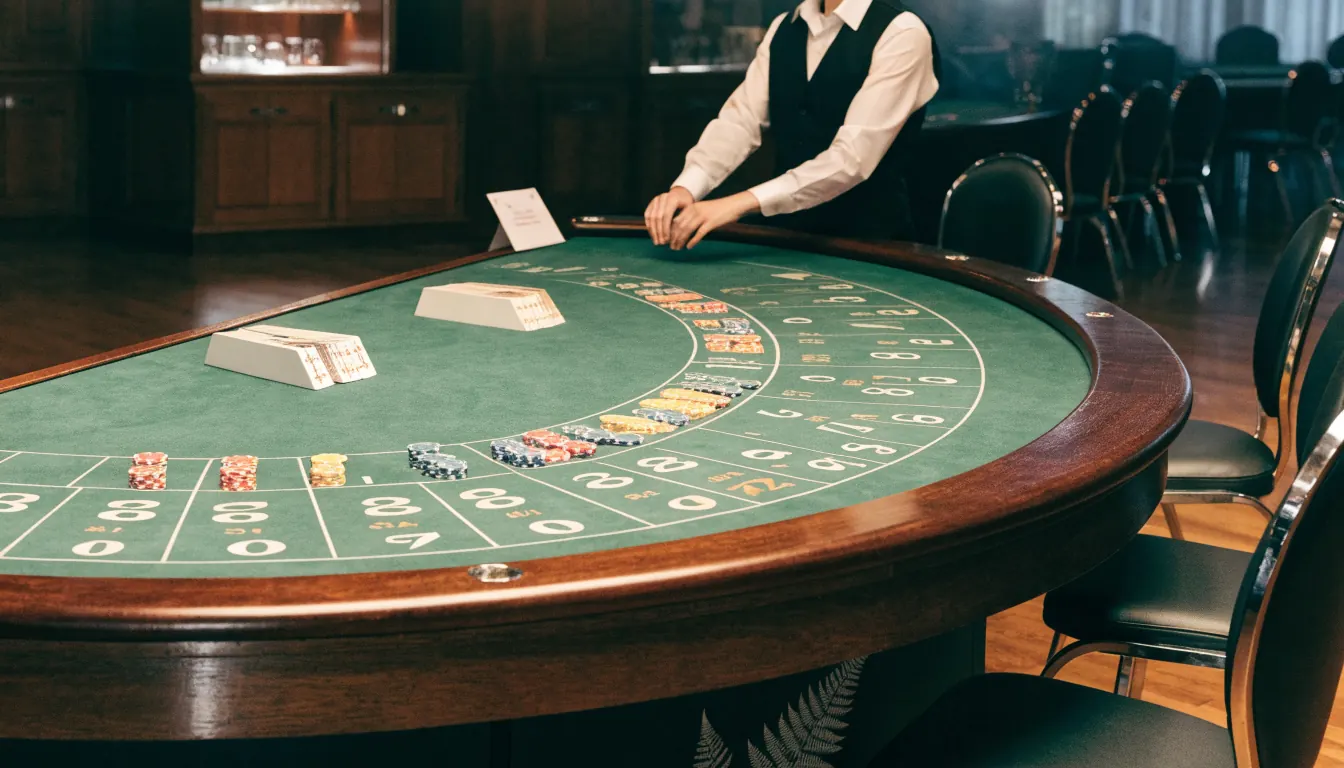
How a Blackjack Table Works
Blackjack is a contest between each player and the dealer, rather than a contest among the people seated at the same table. The aim is to finish with a hand closer to 21 than the dealer’s hand, without going over 21. That objective gives the table its basic structure: players make individual hands, while the dealer represents the common opposing hand.
At a physical blackjack table, the dealer works from a station across from the players. The curved or angled edge of the table gives several people room to take part, with a separate playing position for each hand. The layout helps distinguish the individual decisions and cards associated with each position from the dealer’s cards. Players share the same dealer and round, but one player’s hand is not measured against another player’s.
A round proceeds through a sequence of dealing and comparison. Players receive cards for their hands, and the dealer also forms a hand. The central question is whether a player’s final total is nearer to 21 than the dealer’s, while remaining within 21. A hand that exceeds 21 cannot meet that objective. The dealer’s hand therefore provides the reference point for each player’s result; the table is not a race to outscore the other people seated around it.
The layout of a casino blackjack table is designed to make the game visible and orderly. A player’s cards and playing position are kept distinct from neighbouring hands, while the dealer’s position gives the round a shared focus. This arrangement matters in a social setting: several hands can be in progress in the same round, but each belongs to a particular player. The dealer manages the common dealing process, and the players follow the state of their own hands in relation to the dealer.
A 21 blackjack table follows this same basic premise. The name refers to the target at the centre of the game, not to a separate objective in which players compete to reach a total of 21 regardless of the dealer. Reaching 21 is not, by itself, the only consideration; the hand must also be compared with the dealer’s and must not exceed the target. This distinction explains why the game is often described as dealer-versus-player blackjack.
The experience changes according to whether the table is physical or presented through a screen. In a land-based casino, the cards are dealt at the table in front of the participants. In live-dealer play, actual cards are also used, with the action transmitted to people playing remotely. The streaming format can resemble being present at a casino table, because the dealing is performed with physical cards rather than represented solely by a software-generated card sequence. It is still a remote experience: the video feed is the connection between the dealer’s table and the participant’s screen.

A live blackjack table therefore combines a physical dealing process with a digital viewing interface. The cards exist at the dealer’s table, while the remote participant sees the game through a stream. Streaming can introduce a delay between events at the table and their appearance on screen. Live games may also require higher bets than other formats, so the presentation alone does not establish that every table is suitable for every player. These are practical differences in how the game is delivered, not changes to the central dealer-versus-player objective.
An online casino blackjack table can also be represented as a screen-based interface rather than a camera view of a dealer. In either case, the screen organises the information needed to follow the round: the player’s position, the cards associated with the hand and the dealer’s hand. The visual design may resemble a physical table, but resemblance does not mean that every online game uses physical cards. The distinction is clearest when a live dealer and actual cards are visible; other digital presentations need not reproduce a casino floor.
The phrase “blackjack table” can thus refer to both a physical place and a game interface. At a casino, it describes the shared surface where a dealer handles the cards and participants occupy separate positions. Online, it can describe the on-screen arrangement through which a hand is played, either with a live dealer or through a digital presentation. In both settings, the essential relationship remains the same: each player’s hand is assessed against the dealer’s, with 21 as the boundary the player must not exceed.
Rules, Soft 17, and Blackjack Payouts
Blackjack table rules determine how card values are combined, which actions are available and how a winning hand is paid. The basic objective remains to finish closer to 21 than the dealer without going over, but details can differ from one game to another. A table guide is therefore most useful when it describes the particular game, rather than implying that every casino follows identical conditions.
Number cards count at face value, while jacks, queens and kings each count as 10. An ace can count as either 1 or 11, depending on which value gives the hand a better total without exceeding 21. A hand whose ace is counted as 11 is called a soft hand; if the ace must count as 1 to avoid going over, the hand is hard. The distinction matters when a rule refers to the dealer’s treatment of soft 17.

A soft 17 is a dealer hand totalling 17 with an ace counted as 11. The table may require the dealer to hit that hand or to stand. These are different conditions: hitting gives the dealer another card, while standing ends the dealer’s drawing. The displayed rule should be read as part of the game’s terms, not inferred from the layout or from the actions permitted to players. A specialist review identifies the dealer’s soft-17 rule among the conditions that can vary between games.
Players may be offered the core actions of hitting, standing, doubling down and splitting. Hitting adds a card to the hand; standing ends the player’s turn. Doubling down and splitting are separate options governed by the table’s rules, so their availability should not be assumed solely from the fact that a game is blackjack. Some tables also allow surrender, which ends the hand under a rule-specific condition. The permitted actions and any conditions attached to them form part of the casino blackjack table rules.
A natural blackjack is a starting hand made from an ace and a card worth 10. Its payout is distinct from the ordinary return on a hand that reaches 21 after taking further cards. A specialist review reports both a 3:2 payout for a natural blackjack and tables offering 6:5. These are different payout terms, not interchangeable ways of writing the same return. The stated ratio should be checked in the table rules, since the payout affects what a winning natural returns relative to the original wager. It should not be assumed that the payout shown for one blackjack game applies to another.
Other game conditions can also affect how a hand unfolds. The number of decks in use may differ, as may the dealer’s soft-17 rule, surrender availability and natural-blackjack payout. A specialist review describes these as variable features rather than fixed elements of every game. The combination matters: a rule that changes the dealer’s drawing or a player’s available options alters the circumstances in which a hand is resolved. Blackjack variants can consequently differ in strategy and house edge, even though they share the same broad objective.
This is why a blackjack table guide should separate basic card values from rules specific to a particular game. Card values provide the common foundation, but they do not establish whether the dealer hits soft 17, whether surrender is allowed or what a natural blackjack pays. Those details belong in the stated rules for the table. A blackjack table price, if that phrase is used to mean the cost of playing, is not a single rule of the game: the relevant conditions and any financial terms depend on the table. No payout ratio alone describes every feature that shapes a hand.
Reading the conditions together gives a clearer account of the game than relying on a general label such as standard blackjack. The same hand can be treated differently under different dealer rules, and a natural can receive a different payout under different terms. These distinctions describe the game’s mechanics; they do not guarantee a particular result for any hand.
Online Blackjack in New Zealand in 2026
Choosing a blackjack table in New Zealand involves more than the game itself, so it helps to check the available operator information before deciding where to play. This list provides a concise reference for the operators covered on this page.
-
N1 Casino
- License
- Malta Gaming Authority, licence no. MGA/B2C/394/2017
N1 Casino lists a Malta Gaming Authority licence, number MGA/B2C/394/2017.
-
Wintino
- Payout speed
- 1-3 business days
Wintino lists a payout speed of 1–3 business days.
-
Neospin
- License
- Tobique Gaming Commission, licence no. 0000064
Neospin lists a Tobique Gaming Commission licence, number 0000064.
-
7Bit Casino
- License
- Tobique Gaming Commission, licence no. 0000091
7Bit Casino lists a Tobique Gaming Commission licence, number 0000091.
-
Zotabet
- License
- 07017519840
- Payout speed
- 1-3 business days
Zotabet lists licence number 07017519840 and a payout speed of 1–3 business days.
-
BitStarz
- License
- Curaçao Gaming Authority, licence no. OGL/2024/165/0185
BitStarz lists a Curaçao Gaming Authority licence, number OGL/2024/165/0185.
-
Play Grand
- License
- Malta Gaming Authority, licence no. MGA/B2C/370/2017
Play Grand lists a Malta Gaming Authority licence, number MGA/B2C/370/2017.
-
Lamabet
- Payout speed
- 1-3 business days
Lamabet lists a payout speed of 1–3 business days.
-
Ricky Casino
- License
- Tobique Gaming Commission, licence no. 0000002
Ricky Casino lists a Tobique Gaming Commission licence, number 0000002.
Online blackjack can be delivered through software or by a live dealer, but the two formats differ in how cards are handled and how quickly a hand proceeds. RNG games use software shuffles and generally move faster because play does not depend on a dealer physically dealing cards. Live-dealer games use actual cards, with the table streamed to players. Streaming can introduce delays, and live tables may require higher bets than software games.
These differences describe the format, not the legal status of a service. In New Zealand, online casino gambling is undergoing a change in regulation during 2026. The Online Casino Gambling Act 2026 took effect on 1 May 2026, establishing the country’s first domestic licensing framework for online casino gambling. Domestic online casinos had not been permitted under the earlier Gambling Act 2003.
The transition provisions distinguish between providers already serving people in New Zealand and those seeking to enter the market. A provider that was operating in New Zealand before 1 May 2026 may continue during the transition, which ends on 1 December 2026. To continue beyond that period, providers must apply for a licence; those that have not applied are required to stop operating in the country by the transition’s end. The full licensing regime is not expected to be operational until 2027, so 2026 is a transitional year rather than a settled picture of the licensed market.
Regulatory responsibilities are divided. The Department of Internal Affairs is New Zealand’s primary gambling regulator and oversees the online casino licensing framework. The Gambling Commission hears and determines casino licensing applications, issues online casino licences, and approves changes to licence conditions. These functions concern the regulation of providers; the existence of a new framework does not mean every online blackjack service is locally licensed during the transition.
Before the Act came into force, offshore online casino gambling was not subject to licensing or supervision by a New Zealand regulator. Such websites could be accessible to people in New Zealand, and a customer who wagered with an offshore site in that period had no domestic government recourse. The legal framework now provides for a transition and licensing process, but the dates and status of that process matter when interpreting claims about a service’s regulatory position.
Accordingly, the phrase “blackjack table casino” can refer to materially different settings: a software game, a streamed live table, or a service operating under transitional arrangements. A visual live table does not by itself establish that its provider holds a New Zealand licence. Likewise, the use of RNG software does not determine licensing status. Format and regulatory standing are separate questions.
The law also places restrictions on providers’ market activity during the transition. Online casino gambling services are not to be advertised to people in New Zealand during this period. The eventual licensing regime is expected to involve stricter age and identity checks for licensed operators, while advertising by licensed providers is subject to tight rules and sponsorships are prohibited. These requirements concern operators rather than the mechanics of a blackjack hand.
For a view of online blackjack in New Zealand in 2026, the central distinction is therefore twofold: RNG and live-dealer games differ in delivery and pace, while the Act’s transition determines how providers may operate. Neither game format alone identifies whether a provider is licensed, and the new domestic licensing system is not expected to be fully operational until 2027.
Strategy, Variants, and Card Counting
Blackjack strategy is conditional rather than universal. A decision that fits one version of the game may not fit another, because variants can change both the choices available and the house edge. A basic strategy guide is therefore useful only when its assumptions match the table being played. A chart or probability reference cannot be treated as a rule for every game.

Before applying a strategy, the relevant conditions include the number of decks, how the dealer plays a soft 17, whether surrender is available, and the payout for a natural blackjack. These features can affect the comparison between possible actions. A blackjack pay table may help identify payout terms, but it does not, by itself, establish that a strategy written for a different set of rules applies. Where rule details are unclear, the sound conclusion is that the guide’s applicability is uncertain.
Strategy also depends on the hand and the dealer’s visible card. Basic strategy organises decisions around those conditions, rather than prescribing one action for every hand. It is a method of choosing among the options permitted by a particular game, not a prediction of the next card or a promise of favourable results. Even when decisions follow a suitable chart, individual outcomes remain uncertain.
The term “private blackjack table” describes an arrangement or setting, not a distinct strategic advantage. Privacy does not establish that a game has different odds or more favourable rules. Those conclusions require evidence about the actual rules and game conditions. The same caution applies to a blackjack probability table: numerical-looking guidance is meaningful only if it refers to the variant being played and states the assumptions behind it. No table can remove uncertainty from a hand.
Rule variation matters when adapting a strategy. If surrender is offered, for instance, a strategy reference that assumes it is unavailable may not cover the decision at hand. Likewise, a change in dealer procedure or blackjack payout can alter the conditions on which a recommendation rests. Strategy should therefore be read as rule-specific guidance, not as a fixed sequence detached from the game.
Card counting is a separate practice from basic strategy. It involves keeping a mental estimate of the cards that have appeared and using that estimate to inform later decisions. Under New Zealand law, card counting performed solely through mental calculation is not illegal. That limited legal point does not establish that counting will be effective, welcome at a particular venue, or useful in every format. In online RNG games with automatic shuffles, card counting should not be presented as an effective method: the software shuffle prevents a player from relying on a continuing count of exposed cards in the way the practice requires.
Nor does the legal status of mental calculation make it a guaranteed way to win. Blackjack variants differ, and their rules can affect both strategy and house edge. A system cannot remove those conditions or ensure a positive result. Insurance should generally be avoided by most players as a betting choice; it is not a way to protect a session from losses.
Money management is distinct from hand strategy. A set budget and a decision not to chase losses can limit exposure, but neither changes the game’s probabilities. Where play is tied to a promotion, the terms should be read carefully on a trustworthy site before money is committed: blackjack may contribute differently to wagering requirements, and maximum-bet rules may apply while those requirements are active. These conditions can affect the practical value of an offer without changing the best decision on a particular hand.
Bets, Chips, and Electronic Blackjack
At a physical blackjack table, a wager is represented by chips placed in the designated betting area before a hand begins. The dealer handles the cards, while each player’s chips remain associated with that player’s position. This makes the wager visible during the hand, but it does not change the underlying objective or determine which playing action is available.
A table’s betting procedure is specific to its rules. The point at which betting closes, how a wager is placed, and how chips are collected or paid are part of the table’s operation. These details should be distinguished from the rules for playing a hand: a wager sets the stake for that round, whereas actions such as hitting, standing, doubling down, or splitting affect how the hand proceeds.
An electronic blackjack table game replaces physical chips and cards with a digital interface. A player selects a wager through on-screen controls, and the game records it as a digital balance rather than as chips on felt. The software also manages the cards. In RNG blackjack, software shuffles the virtual deck, and rounds can proceed faster than in live-dealer games because there is no streamed dealer handling physical cards.

That difference in pace is material to the wagering experience. Faster rounds mean that decisions and new wagers can occur in quicker succession. The interface may make the amount assigned to a hand easy to see, but it does not remove the need to track how much is being staked over a session. A budget set in advance, with play stopping when it is reached, is a practical safeguard; increasing stakes to recover losses can compound them.
Live-dealer blackjack combines digital wagering with a physical table. The wager is entered electronically, while actual cards are dealt and shown through a stream. This format therefore differs from both a conventional table, where chips are handled in person, and RNG play, where the cards are generated and shuffled by software. Streaming can introduce delay, and live-dealer games may require higher bets than other formats.
Promotional terms can also affect how a blackjack wager is treated. Blackjack may contribute differently from other games toward wagering requirements, and maximum-bet rules may apply while those requirements are being met. The conditions can depend on the offer and the platform, so they should be read before funds are committed. Fine print and bonus conditions should be checked on trustworthy sites and casinos; a displayed balance alone does not establish how a wager will count.
The distinction between chips, digital credits, and streamed dealing is chiefly a distinction in how a wager is placed and how a round is delivered. It does not establish that one format produces better results. In particular, the faster pace of RNG play is a feature of delivery, not evidence of a more favourable outcome.
When to Hit, Stand, Double, or Split
The hit-or-stand choice turns on whether another card is wanted or the current hand should be kept. Hitting adds a card; standing ends the player’s turn with the hand as it stands. The aim remains to finish closer to twenty-one than the dealer without going over, but that objective alone does not determine the correct action for every hand. The choice depends on the cards in hand and the rules in force.
A blackjack hit-or-stand table can serve as a reference for comparing a hand with possible actions. It is not a substitute for knowing which rules apply: a chart may be designed for a particular set of table conditions, so its recommendations cannot automatically be carried over to every game. A decision aid also does not ensure a favourable result on an individual hand.
Doubling down is a separate option from simply taking another card. When the table permits it, the player increases the stake and receives a card under the conditions of that game; the option is therefore different from hitting repeatedly. The exact procedure and restrictions are determined by the table rules. A player considering whether to double needs to distinguish this committed action from a hit, which leaves the hand open to further decisions.
Splitting applies when the initial cards form a pair and the rules allow them to be separated into separate hands. Each hand then requires its own play decisions. Whether splitting is available, and what follows after the split, depends on the game. It should not be treated as an automatic choice merely because two cards match: the resulting hands must still be played under the table’s conditions.
Surrender may also be offered. Where available, it allows a player to give up the hand under the applicable rules rather than continue playing it. Since not every table offers surrender, its presence should be confirmed before relying on it as an option.
The wording “hit or stand” can make the decision seem binary, but doubling, splitting and sometimes surrender add other possibilities. The question of what the maximum bet is at a table described by a particular minimum stake has no universal answer based on that label alone. Maximums are table-specific, so the minimum stake should not be read as a statement of the upper limit. The available choices during a hand and the permitted stake range are separate details, both governed by the rules shown for that game.
Choosing a Seat at a Blackjack Table
Choosing a seat is a practical decision, not a demonstrated way to improve the chance of winning. Blackjack is played against the dealer, with each player trying to finish closer to 21 without going over. The position occupied around the table does not, by itself, change that objective. There is no established universally advantageous place to sit.
A seat can affect how clearly the table is visible. From some positions, cards, the dealer’s actions or table markings may be easier to see; from others, sightlines may be less direct. This is a matter of comfort and observation, not evidence that one position produces better outcomes. A seat should allow the game to be followed without repeatedly leaning around another player or losing sight of the action.
The amount of space available can also matter. Blackjack tables bring several players together, and a crowded position may feel less comfortable than one with more room. Where seats are open, the surrounding players and the pace of the table may influence whether a position feels suitable. These considerations can shape the experience, but they do not establish a betting advantage.
At a live table, position determines where a player sits in relation to the dealer and other participants. It does not give a player control over the dealer’s cards or make the outcome predictable. Claims that a particular seat is best should therefore be treated cautiously unless supported by evidence that directly demonstrates a difference in results. Familiar beliefs about sitting at one end or another are not enough to establish such an effect.
The phrase “best place to sit at a blackjack table” has no single answer that applies across tables and players. A position that offers a clear view may suit one person, while another may prefer a quieter or less exposed spot. Practical preference is a reasonable basis for choosing, provided it is not confused with a change in the game’s odds.
Seat choice should also be kept separate from decisions made during a hand. A comfortable location may make it easier to follow the table, but it does not replace understanding the game or its rules. Nor does moving seats provide a reliable method for recovering losses or securing a particular result. The available evidence supports treating position as a matter of visibility and personal comfort, rather than as a system for gaining an edge.
Reading a Blackjack Card Chart
A blackjack card chart is a reference for interpreting a hand and identifying the actions listed for a particular situation. It is useful only when its layout and assumptions are understood: a chart does not describe every table, and its recommendations cannot be applied reliably without knowing which rules it was made for.

The values shown for cards are the starting point. Number cards retain their face values, face cards count as ten, and an ace may count as one or eleven. That flexibility means a chart may distinguish between hands with an ace counted as eleven and hands where it must count as one. When reading a row or column, the player’s hand and the dealer’s exposed card need to be matched to the chart’s labels; a value alone may not identify the correct entry.
The chart’s action key should also be checked. Depending on the hand and the table rules, available choices can include hitting, standing, doubling down, splitting, or surrendering. Abbreviations are not universal, so the key or accompanying explanation matters. A chart that uses an unfamiliar symbol should not be interpreted by guesswork.
Applicability depends on the game’s conditions. The number of decks, the dealer’s treatment of soft 17, surrender availability, and the payout for a natural blackjack can differ between games. A specialist review has reported both 3:2 and 6:5 natural-blackjack payouts, but that report should not be treated as confirmation of the terms at a particular table. A chart prepared for different rules may therefore show actions that do not fit the game being played.
A practical check is to compare the chart’s stated rules with the table information before relying on it. If the chart does not identify its assumptions, its guidance has limited interpretive value. The chart can organise decisions and clarify how hand labels are used, but it is not a substitute for knowing the rules that govern the specific game.
What a Blackjack Cheat Sheet Can—and Cannot—Show
A blackjack cheat sheet is a compact reference, not a forecast of how a hand will end. It can summarise the values assigned to cards: number cards retain their face values, face cards count as ten, and an ace may be treated as either one or eleven. It can also set out the actions available at a particular table, such as hitting, standing, doubling down or splitting. Whether surrender is included depends on the rules in force.

That makes a table-side reference useful for recalling basic information without treating it as a complete account of every game. A condensed guide may assume particular rules, while another table may use different conditions. Blackjack variants do not share one universal rule set, and those differences can alter which decisions are appropriate and the house edge. A cheat sheet therefore needs to be read in context rather than applied automatically.
The limits are important. A summary cannot guarantee a favourable result, remove the house edge or account for every situation arising in a hand. Nor does memorising a sequence of actions make outcomes predictable. The guidance represents a decision reference under stated assumptions; it is not a system for winning.
Before relying on a blackjack cheat sheet, its assumptions should be compared with the rules displayed for the game. If the reference does not identify the conditions it covers, its recommendations may not fit the table. A concise layout can also omit qualifications that matter, so brevity should not be mistaken for completeness.
A reference is best treated as support for understanding card values and available choices, not as a substitute for reading the table rules. Gambling outcomes remain uncertain, and a cheat sheet does not change that. If play involves real money, a budget set in advance can help contain spending; losses should not be chased.
Table Limits and Rule Differences
A blackjack table’s limit is a condition of that particular game, not a reliable guide to every table at a venue. The posted minimum and maximum stakes, where shown, should be read alongside the rules for the game. No specific maximum stake can be established for New Zealand tables generally, or for a venue identified as The Paris; a venue name alone does not establish the terms of an individual table.

Other conditions can differ from one game to another. A specialist review notes variation in deck count, whether the dealer stands or hits on soft 17, surrender availability and the payout for a natural blackjack. These details affect what a table offers, so two games labelled blackjack should not be assumed to have identical conditions. The relevant rules should be checked at the table or in the game information before wagering.
The payout distinction is material. The same specialist review describes a 3:2 natural-blackjack payout at some tables and a 6:5 payout at others. Those figures are examples of differing terms reported in that review, not a statement of a standard applying across New Zealand. The payout attached to a particular game must be confirmed directly; the word “blackjack” alone does not specify it.
Limits and rules should therefore be considered together rather than treated as separate details. A table’s stake range says what wagers it accepts, while its rules determine conditions such as the natural-blackjack payout and whether surrender is available. Neither can safely be inferred from the venue name or from the appearance of a familiar table layout.
For online games, the information displayed for the selected table is also the relevant reference, since game conditions may vary between offerings. A listed limit does not, by itself, indicate that the rules match those of a physical table. Careful comparison means identifying the particular game and reading its stated limits and rules, rather than relying on a general description or assuming that all blackjack tables use the same terms.

Live & Card Games in New Zealand: Blackjack and Baccarat
Content created by the «casinoinfonz.com» team