
Learn the choices behind every blackjack hand
 Available in US
See how card values, hand decisions, table rules and online formats shape play against the dealer.
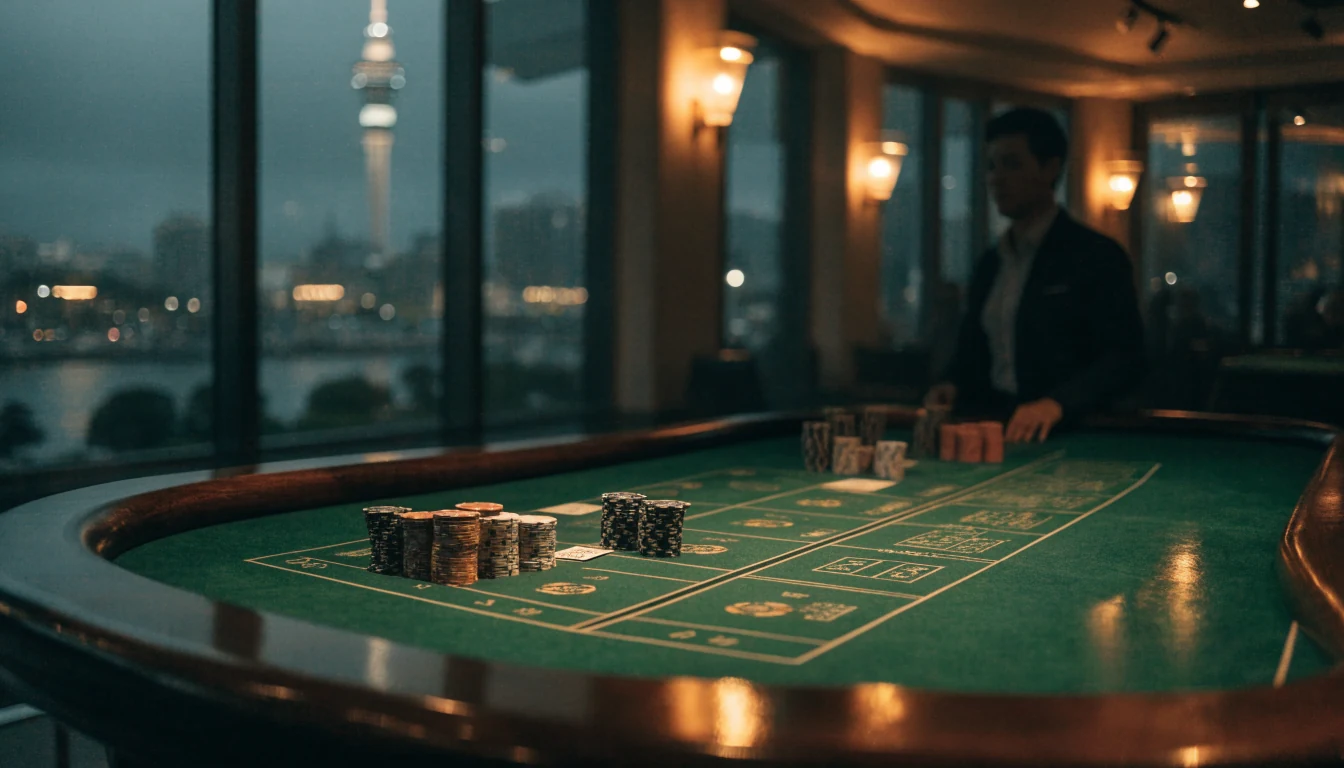
The Aim of a Blackjack Hand
Blackjack is a card game built around a simple target: make a hand total closer to 21 than the dealer’s hand, without going over 21. The aim is not to collect as many cards as possible or to match the dealer’s total exactly. Each card contributes a value, and the values are added together to give the hand’s score.
The comparison is between each player’s hand and the dealer’s. A total below 21 can still be a strong result if it is nearer to the target than the dealer’s final total. Reaching 21 is not required in every hand; a lower total may be sufficient. The limit matters just as much as the target: a hand that exceeds 21 has gone too far, so a player must balance the desire to improve a total against the risk of crossing that limit.
How card values work
Number cards count as the number shown on them. A card marked 2 contributes two points, while a card marked 9 contributes nine. When several number cards are held, their values are added. For instance, a hand containing a 4 and an 8 has a total of 12.
Choosing where to play blackjack in New Zealand in 2026 calls for a careful look at the information available about each operator. This list gives you a concise reference point before you decide where to explore further.
-
N1 Casino
- License
- Malta Gaming Authority, licence no. MGA/B2C/394/2017
N1 Casino is listed with a Malta Gaming Authority licence, number MGA/B2C/394/2017.
-
Wintino
- Payout speed
- 1-3 business days
Wintino lists a payout speed of 1–3 business days.
-
Neospin
- License
- Tobique Gaming Commission, licence no. 0000064
Neospin is listed with a Tobique Gaming Commission licence, number 0000064.
-
7Bit Casino
- License
- Tobique Gaming Commission, licence no. 0000091
7Bit Casino is listed with a Tobique Gaming Commission licence, number 0000091.
-
Zotabet
- License
- 07017519840
- Payout speed
- 1-3 business days
Zotabet lists licence identifier 07017519840 and a payout speed of 1–3 business days.
-
BitStarz
- License
- Curaçao Gaming Authority, licence no. OGL/2024/165/0185
BitStarz is listed with a Curaçao Gaming Authority licence, number OGL/2024/165/0185.
-
Play Grand
- License
- Malta Gaming Authority, licence no. MGA/B2C/370/2017
Play Grand is listed with a Malta Gaming Authority licence, number MGA/B2C/370/2017.
-
Lamabet
- Payout speed
- 1-3 business days
Lamabet lists a payout speed of 1–3 business days.
-
Ricky Casino
- License
- Tobique Gaming Commission, licence no. 0000002
Ricky Casino is listed with a Tobique Gaming Commission licence, number 0000002.
All face cards have the same value: 10. A jack, queen or king therefore contributes ten points, regardless of its suit or rank. A face card combined with a 6 gives a total of 16. The suit of a card does not change its blackjack value, and the face cards do not have distinct scores from one another.
An ace is different because it can count as either 1 or 11. Its value is treated in the way that gives the hand a useful total without taking it above 21. An ace with a 7 can therefore be counted as 8 or 18. If the hand also contains a 5, counting the ace as 11 would produce 23, so it must instead count as 1, making the total 13.
This flexible value is why an ace can make a hand less fixed than one made only of number and face cards. A hand with an ace may be described as soft when the ace is counted as 11 without the total exceeding 21. If the ace has to count as 1 to keep the hand within the limit, the total is hard. The terms refer to the way the hand is scored, not to different kinds of cards or separate rules.

Consider an ace and a 6. Counted with the ace as 11, the hand totals 17. If another card would make that total exceed 21, the ace can instead be valued at 1, reducing the score by ten points. By contrast, a hand containing a 10 and a 7 totals 17 with no alternative ace value. Its score is fixed unless another card is added.
The target is not simply 21
The phrase “blackjack 21” can suggest that the sole objective is to reach exactly 21, but the hand is judged in relation to the dealer’s total. A hand of 20 is already close to the target and may finish ahead of the dealer. A hand of 18 can also be enough if the dealer finishes lower. Conversely, a total of 20 does not guarantee the hand will beat the dealer if the dealer reaches 21.
Going over 21 is called busting. The total is then beyond the permitted range, rather than a stronger score. This makes the target a boundary as well as a goal: the value of a hand depends not only on how near it is to 21, but also on whether it remains at or below that number.
A natural blackjack refers to an opening hand made from an ace and a 10-value card. Its total is 21, reached with those two cards. Other combinations can also total 21, but the word “natural” distinguishes this particular starting hand. The card values explain why: the ace can count as 11, and a face card or 10-valued card supplies the remaining ten points.
Understanding this scoring is the foundation for how to play blackjack at a casino. Before considering any choice during a hand, the relevant questions are what each card contributes, whether an ace can be counted as 11, and how the resulting total compares with 21. The same arithmetic applies whether the cards are dealt physically or displayed on a screen; the scoring itself is not changed by the setting.
For someone learning how to play blackjack, the central idea is therefore comparison rather than accumulation. The player’s hand is measured against the dealer’s, with 21 as the ceiling. Card values determine the total, an ace can adjust between 1 and 11, and any total above 21 has exceeded the limit. Once those points are clear, the outcome of a hand can be understood without treating every card as a separate puzzle.
How a Turn Works: Hit, Stand, Double Down, or Split
A blackjack turn is a choice about whether to take another card, keep the hand as it is, or change how the hand is played. The available actions are hit, stand, double down, and split. Which choices are permitted can depend on the table’s rules.
A hit means requesting another card. It can improve a hand, but it can also push its total over the limit and end the hand as a loss. A player may take further cards while choosing to hit remains available. The decision is therefore not simply whether another card could help: it also involves the risk of exceeding the limit.
A stand means taking no more cards. The hand remains at its current total, and the player’s turn ends. Standing can preserve a total that seems sufficient, but it also means giving up the chance to improve it with another card.

With a double down, the player increases the wager on the hand and takes a further card, then stands. This makes the choice more consequential than an ordinary hit: the hand’s outcome affects a larger wager, while the player does not continue drawing cards afterward. The option is subject to the table’s rules.
A split separates an eligible pair into two hands. This creates a separate decision for each hand, and each can produce a different result. Splitting also changes the wager involved, so it is not merely a way to rearrange cards. The specific conditions for splitting, and the actions allowed afterward, depend on the game.
For a beginner, the practical sequence is to inspect the hand, identify which actions are available, and consider what each choice changes. Hitting changes the cards in the hand; standing ends the turn; doubling down raises the stake and limits further drawing; splitting creates another hand to manage. The same action can have different consequences depending on the cards and the table rules. Knowing the names of the choices is only the starting point: the rules shown at the table determine when each can be used.
Blackjack Online: Free RNG Games and Live Dealers
Online blackjack is available in two broad formats: games in which software shuffles and deals the cards, and live-dealer games in which actual cards are used and the table is streamed. Both present blackjack through an online interface, but they differ in how the cards are produced and how quickly a hand can progress. Those differences affect the experience more directly than the basic rules of the game.
Software-based (RNG)
Uses a random number generator for shuffles and deals, allowing for a faster pace of play.
Live-dealer
Actual cards are used and streamed from a casino-style table, providing a more physical experience.
Software-based blackjack
In a random number generator, or RNG, game, software determines the shuffle and deals the cards on screen. This format allows faster play than live-dealer blackjack. There is no streamed table to follow, so the sequence of play can move at the pace set by the game interface. The distinction is about the way a game is delivered; it does not change the underlying aim of blackjack.
Some online games may offer a free-play mode, while others may not. Where it is available, the interface can allow a person to explore the software version without placing a real-money wager. A game described as free should not automatically be taken to mean that every blackjack title has a no-cost option, or that a particular title can be accessed in every location. Availability depends on the game and the service providing it.
A software game may be accessible through a browser or another interface, but “no download” is not a feature that can be assumed for every title. The relevant distinction is whether the particular game can be opened in the available interface without installing additional software. Online presentation alone does not establish that detail.

The faster pace of RNG blackjack can make the experience feel more continuous than a streamed table. It also means that the game is not showing a physical dealer handling cards. The cards appear through software, and the shuffle is software-based. For someone comparing formats, that is a material difference: a digital representation of a deal is not the same thing as watching actual cards being dealt, even though both formats provide online blackjack.
Live-dealer blackjack
Live-dealer blackjack uses actual cards and is streamed from a casino-style table. This makes it more like sitting at a casino table than a software-only game. The stream presents a physical dealing process rather than a shuffle and deal represented solely by software. This difference is central to the format, although the streamed setting remains an online experience rather than attendance at a physical table.
Streaming can affect the pace. A delay in the video or its delivery may interrupt the sequence of play, so a live game can feel slower or less continuous than an RNG game. The extent of any delay can vary; it should not be treated as a fixed feature of all live tables. A streamed game also depends on the video reaching the viewer, whereas an RNG game does not require a live card deal to be shown.
Live-dealer games may require higher bets than software-based games. That possibility matters when comparing formats, but it does not establish a universal minimum or imply that every live game has the same betting conditions. The relevant terms are specific to the table. The format alone is not enough to determine whether a game is suitable for a particular budget.

Choosing between formats
The choice is therefore not simply between a “real” game and an artificial one. Live blackjack uses real cards, while RNG blackjack uses software shuffles; both are online versions of the game. A preference for seeing cards dealt at a table may point towards live play. A preference for a faster sequence may point towards an RNG game. Neither distinction, by itself, establishes which format is better.
People looking to play blackjack online for free should distinguish the game format from the cost of access. RNG describes how cards are shuffled and dealt, not whether play is free. Live-dealer describes a streamed table using actual cards, not whether a free mode is offered. A free-play option, where available, is a separate feature of the service or game. It should be checked on the relevant game screen rather than inferred from the words “online blackjack.”
The same care applies to a game that appears playable without a download. That describes an access method, not the way the cards are generated. A browser-based game could still be software-based, while a live-dealer game relies on streaming. The type of interface and the type of game are related but distinct questions.
For a comparison, the practical points are the source of the deal, the pace, and the conditions attached to the table. RNG blackjack uses software shuffles and can move faster. Live blackjack shows actual cards, but streaming can delay play and the table may require higher bets. Beyond those stated differences, details such as free access and installation requirements depend on the individual game. A careful description should keep these categories separate instead of treating “online,” “free,” and “live” as interchangeable labels.
Free Play as a Way to Learn the Game
Free play can provide a low-pressure setting for becoming familiar with blackjack’s layout and pace. It allows attention to stay on the game rather than on the consequences of a wager, which can make it easier to notice how the interface responds to a decision or displays the result of a hand. The experience is still a simulation: it can support familiarity, but it does not reproduce every condition of playing for money.
A free version may be available in a browser, while other versions may require an app or account. Those details depend on the game and the platform; a no-download option should not be assumed. Where a browser version is offered, it can be opened without installing a separate program. The page should make clear whether play is free and whether registration is required before any details are entered.
Practice without a wager
A session without real-money stakes can help establish a basic routine. The game’s controls, prompts and result displays become more familiar through use. This is useful for reducing uncertainty about the interface itself, but familiarity with buttons is not the same as a dependable understanding of every table rule. The rules shown in the game remain important, and different versions may present different conditions.
Software-based blackjack uses shuffles generated by software. Such games allow hands to proceed more quickly than live-dealer games, so free play can also reveal whether that pace is comfortable. A faster sequence may make it tempting to act without reviewing the screen. Pausing between hands, or ending a session when attention fades, keeps practice deliberate rather than automatic.
Do
- Use free play to become familiar with the interface
- Observe how the game communicates outcomes
- Read the specific rules of the table
Don't
- Treat free play results as proof of future performance
- Assume one version's rules apply to all games
- Use free play as a substitute for reading the rules
Playing blackjack for fun does not require treating every session as a test of skill. A useful session can have a modest purpose: becoming comfortable with the layout, observing how the game communicates outcomes, or learning where its rules and help information appear. Repeating a particular decision can make its interface easier to recognise, but it does not establish that the same decision will produce a favourable result later.
Sound can be part of the experience where a game includes audio. It may mark a card dealing or a hand’s outcome, but it is not evidence that a result is more reliable or that a particular choice is correct. A free blackjack game with sound may suit players who prefer audible feedback; others may find it distracting and choose to mute it if that setting is available. The presence and control of sound vary, so they are features to check rather than assume.
What free play cannot show
Practice in a free mode does not necessarily match the conditions of a real-money game. The interface may look similar, but the stakes and the player’s response to them are different. Free play also cannot establish that a result in one session predicts results in another. It is best treated as a way to learn the presentation and rhythm of a particular game, not as proof of future performance.
It can also be helpful to distinguish practice from strategy study. A free session may give time to observe how choices are entered and how the game responds, but the rules still need to be read directly. The number of decks, dealer rules, surrender options and payouts can differ between games, and those differences affect how a hand should be assessed. Familiarity with one version should not be carried over automatically to another.
If practice is followed by real-money play, the change in stakes warrants a separate decision. A budget set in advance and a clear stopping point can help keep play within intended limits; losses should not be chased by increasing stakes or extending a session. Before accepting a bonus, the terms should be read on a trustworthy site, including wagering requirements and maximum-bet rules. Blackjack may contribute differently to wagering requirements than other games, so a bonus balance should not be treated as unrestricted funds.
Free play is therefore most useful as a contained learning activity: it can reduce interface uncertainty and offer a chance to experience the game’s pace without a wager. Its limits matter just as much. It does not guarantee access to a particular version, remove differences between game rules, or provide evidence of what will happen in paid play.
Online Casino Rules and Licensing in New Zealand
New Zealand’s online casino rules changed with the Online Casino Gambling Act 2026, which came into force on 1 May 2026. The Act creates the country’s first domestic licensing regime for online casino gambling. The Gambling Act 2003 had not permitted online casinos to be based in New Zealand, while gambling services supplied from offshore had not been licensed or supervised by a New Zealand regulator. Customers using offshore sites during that earlier period had no domestic government recourse.
Responsibility under the new framework is divided between two public bodies. The Department of Internal Affairs is the primary regulator of gambling in New Zealand and oversees regulation of the online casino licensing framework. The Gambling Commission has a distinct licensing role: it hears and determines casino licence applications, issues online casino licences, and approves changes to licence conditions. These functions should not be conflated; the Department’s wider regulatory oversight does not make it the body that decides licence applications.
The transition is not an immediate opening for every offshore casino to operate under a New Zealand licence. Only providers that were already serving people in New Zealand before the Act began may continue during the transitional period, subject to the Act’s provisions. That period runs from 1 May 2026 to 1 December 2026. Providers that have not applied for a licence must stop supplying online casino gambling in New Zealand by the end of that window. If an application is declined, the provider must cease those operations and leave the market. The full licensed regime is not expected to be operational until 2027.
This distinction matters when assessing where to play live blackjack online or whether a site offering blackjack with friends is operating within the framework. Game format does not establish a provider’s licensing status. Nor does the presence of a casino blackjack bonus show that a site has been authorised. During the transition, licensed operators face tight advertising rules, and sponsorships are prohibited; online casino gambling services must not be advertised to people in New Zealand during this period. The rules also require stricter age and identity verification by licensed operators.
A site’s own claims should therefore be read alongside the applicable legal status, rather than treated as proof by themselves. Before any real-money play, bonus conditions and other fine print should be checked on trustworthy sites and casinos. Blackjack may count differently towards wagering requirements, and maximum-bet rules can apply while wagering requirements are in effect. These conditions affect the use of a promotion; they do not indicate whether a provider holds a licence.
The regulatory framework does not identify a single best website for online blackjack, and the licensing process is not a professional-play tip. Licensing concerns whether a provider may operate under New Zealand’s rules; it does not establish that a particular game, bonus, or playing approach is suitable. Where the provider’s status or terms are unclear, the available information may not be enough to support a reliable conclusion. Any play also carries financial risk: a budget should be set in advance, and losses should not be chased.
Strategy Starts with the Table Rules
Blackjack strategy is conditional: a decision that is appropriate under one set of rules may not be the best choice under another. A strategy guide is therefore useful only when its assumptions match the game being played. Before applying advice, the table rules need to be identified rather than treated as identical across all blackjack games.
A specialist review reports that games can differ in deck count, whether the dealer draws on a soft seventeen or stands, whether surrender is permitted, and the payout for a natural blackjack. These are not merely presentation details. They can change the decisions available and the mathematical balance between the player and the house. Blackjack variants also differ in their rules, with consequences for both strategy and house edge.
This is why there is no single, context-free answer to the best way to play blackjack. A strategy chart or guide may assume particular rules, and applying it to a table with different conditions can produce inappropriate recommendations. The guide should state its assumptions clearly. If it does not, its advice cannot be reliably assessed against a specific game.
Rule differences also affect how much a decision is worth. A change to the dealer’s soft-seventeen rule, for instance, alters the conditions under which the dealer continues drawing. A different payout for a natural blackjack affects the return associated with that outcome. The overall effect depends on the full combination of rules; one favourable feature does not establish that a game is favourable overall. House edge is tied to the complete ruleset, not to a single advertised detail.
For someone learning blackjack, the sound starting point is to understand the rules attached to the table and then use strategy material designed for those conditions. This approach makes advice easier to compare and helps distinguish a rule-based recommendation from a general claim about how to play. Where the relevant rules are unclear, confident strategy claims should be treated cautiously.
Strategy also has limits. It can help organise decisions within the rules, but it cannot guarantee a winning result or remove the house edge. Betting systems do not change the underlying rules or provide a guaranteed route to profit. If real-money play is involved, a budget should be set in advance and losses should not be chased. Bonus terms require separate attention: blackjack may count differently towards wagering requirements, and maximum-bet rules can apply while those requirements are active. The fine print and bonus conditions should be checked on trustworthy sites and casinos before play.
Playing with Others and the Limits of Card Counting
Blackjack can be played at a table shared with other players, but the presence of other participants does not make them opponents in the same sense as the dealer. Each player makes decisions about their own hand, while the dealer remains the point of comparison. Whether an online game allows several people to join the same table depends on its format; the availability of a shared table should not be assumed from the game’s name alone.
Playing alongside others can add a social element, but it does not change the basic purpose of card counting. Counting is a method of keeping a mental estimate of cards that have appeared, with the aim of assessing how the remaining cards may affect decisions. It is distinct from a system that promises a reliable profit. No betting method can be treated as a guaranteed way to win.
New Zealand law does not make card counting illegal when it is done through mental calculation alone. That narrow legal point does not establish that every tool or technique associated with counting is permitted, nor does it show that counting is effective in a particular game. The legal position on mental arithmetic should not be extended to software that observes or processes a game automatically.
The question of card-counting software in online blackjack therefore involves separate issues. A tool’s technical ability to follow cards would not, by itself, demonstrate that its output improves decisions or that its use is allowed under a particular game’s rules. Software-based and live formats may also handle cards differently, so conclusions about one format cannot automatically be applied to another. No general claim about the effectiveness of counting online is supported by the legal fact about mental calculation.
Shared play also does not remove the need to understand the conditions attached to a game. Before wagering real money, the relevant rules, fine print and bonus conditions should be checked on trustworthy sites and with the casino. Blackjack may contribute differently to wagering requirements, and maximum-bet rules can apply while those requirements are being met. A budget set in advance, with no attempt to chase losses, keeps those decisions separate from the social pressure of a table or from confidence in a counting method.
Blackjack as a Game Against the Dealer
Blackjack is structured as a contest between each player and the dealer, rather than as a direct competition among the people seated at the same table. The central comparison is between a player’s final hand and the dealer’s hand. The aim is to finish closer to 21 without going over it.
This distinction shapes what other players’ decisions mean. Their hands do not have to be beaten for an individual hand to succeed; the relevant comparison is with the dealer. A table may therefore contain several players making decisions at the same time, but each player’s result is assessed against the dealer rather than against the person in the next seat.
The dealer is not simply another participant in a shared contest. The dealer’s hand is the common point of comparison for the players at the table. A player can finish nearer to 21 than another player and still fail to meet the objective if the dealer’s hand is closer. Conversely, a player’s result does not depend on having the strongest hand among the other players. The relationship is individual: each player’s hand is considered in relation to the dealer’s.
This helps distinguish blackjack from games in which participants compete directly for a shared outcome. In blackjack, the presence of other players does not turn their hands into the main obstacle. Their choices may be visible, but the basic objective remains the same for each seat: compare the player’s hand with the dealer’s and avoid exceeding 21.
A game described as blackjack may be offered in different settings, but this basic opponent structure remains the defining idea. It is what gives the game its name and explains why a table’s other players are not treated as rivals in the same way as the dealer. Understanding that relationship is separate from learning how to make each decision during a hand: the decisions affect a player’s own position, while the outcome is judged against the dealer.
Thus, “playing blackjack” refers not to defeating the whole table, but to pursuing a hand that fares better against the dealer under the game’s objective.
Variants, Blackjack Payouts, and Insurance
Blackjack is not governed by one fixed set of table rules. A specialist review describes differences between games in deck count, whether the dealer hits or stands on soft 17, whether surrender is allowed, and how a natural blackjack is paid. These details affect the conditions of play, so a game’s name alone does not establish which rules apply.

A natural blackjack is a two-card hand consisting of an ace and a ten-value card. A specialist review reports two payout structures: 3:2 and 6:5. These ratios are not interchangeable. For the same stake, a 6:5 payout returns less on a natural blackjack than a 3:2 payout. The displayed rules therefore matter even when two tables appear otherwise similar. The reported structures should not be treated as a guarantee of what any particular game offers; the payout stated for that table is the relevant one.
Other rules can also alter the decisions available during a hand. Depending on the table, a player may be able to hit, stand, double down, split, or surrender. The presence of surrender, for instance, is not universal, and the dealer’s treatment of a soft 17 can differ. These distinctions are part of the game’s terms, rather than minor variations in presentation.
Insurance should be approached cautiously. It is a separate wager, not a necessary part of blackjack play, and it should not be assumed to improve a player’s overall prospects. For most players, avoiding insurance is a more prudent default than treating it as routine. The table’s rules and payout information provide the basis for understanding the offer; the name of the bet alone does not establish that it is favourable.
Comparing blackjack games therefore requires attention to both the natural-blackjack payout and the rules governing play. A lower payout or a rule change can alter the character of a game, even where the basic aim remains familiar.
Simulators, Betting, and Playing More Than One Hand
A blackjack simulator can make the relationship between a wager and in-hand decisions easier to examine without suggesting that any particular tool or game is available. A useful practice exercise is to follow a hand from the initial deal, note the wager, and consider whether to hit, stand, double down, or split when the option is offered. The point is to understand how each choice changes that hand, not to treat a simulated result as evidence of future outcomes.
The rules displayed by a simulator matter. A specialist review of blackjack tables notes that games can differ in deck count, the dealer’s action on a soft 17, surrender availability and blackjack payouts. Those details can change which decisions are available and how a hand plays out. A practice setup that does not match a table’s rules may therefore provide a poor guide to decisions at that table. The rules should be read before interpreting a simulated hand or comparing outcomes.
Considering more than one hand
Some blackjack tables may allow a player to play two hands at once, but this is not a feature that can be assumed across games. Each hand has its own decisions, while the table’s rules determine which actions are permitted. Hitting or standing applies to the hand being played; doubling down or splitting may also be possible when the relevant conditions are met. Surrender is another possible option under some rules.
Playing multiple hands also means managing more than one wager and set of decisions at the same time. It does not change the basic aim of each hand, and it does not ensure a better result. A simulator can help clarify the sequence of decisions, but it cannot make the table’s rules irrelevant.
For real-money play, a budget helps keep wagers within a planned limit; chasing losses can increase risk rather than recover them. Before accepting a bonus, the fine print should be checked on a trustworthy site or casino. Blackjack may contribute differently to wagering requirements, and maximum-bet rules can apply while wagering requirements are being met. These conditions are separate from the rules governing actions within a hand.
Live & Card Games in New Zealand: Blackjack and Baccarat
Content created by the «casinoinfonz.com» team