
Understand the rules before choosing a bingo casino
 Available in US
A practical guide to ticket patterns, online formats, bonuses, payments and the wider casino features that can accompany bingo.
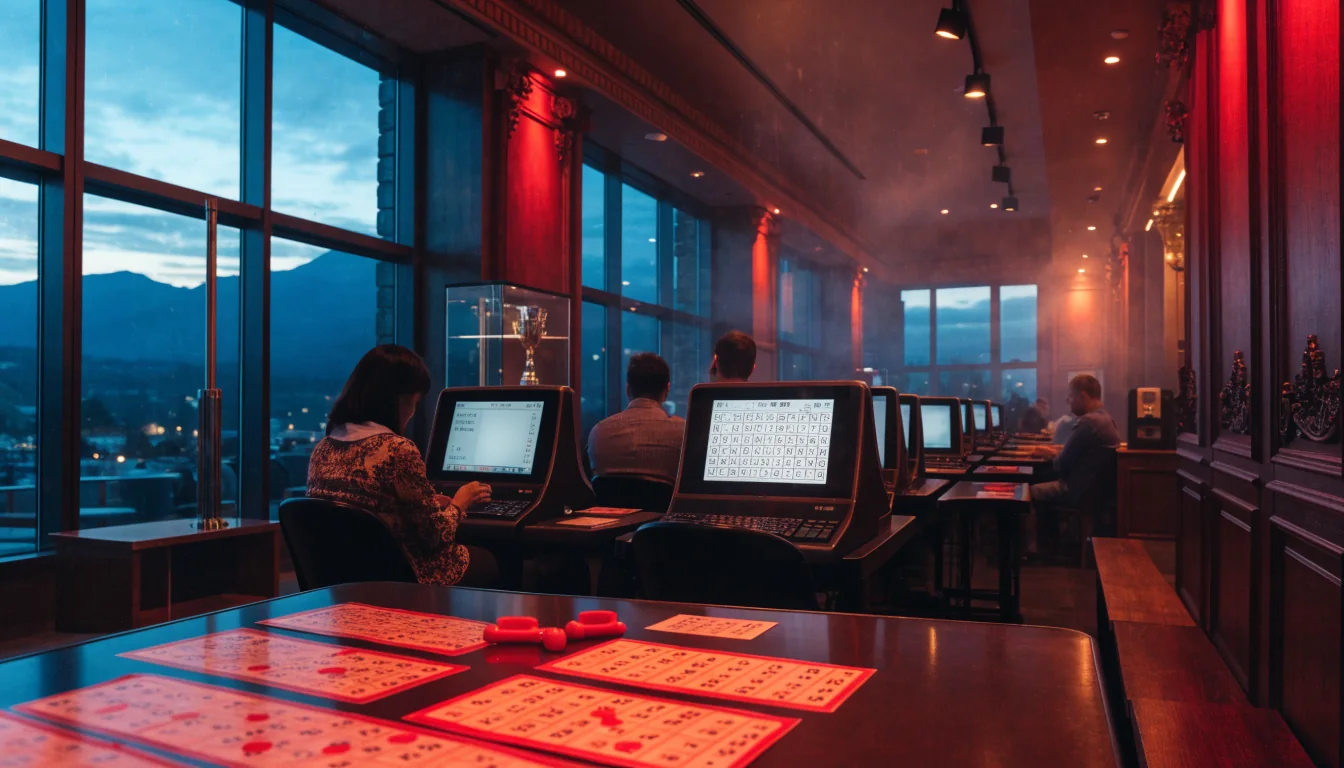
How Bingo Rounds and Tickets Work
Five-line bingo is played on a five-by-five card containing 25 numbered squares. The centre square is numbered rather than free, so every square contributes to the ticket’s pattern. In this version, numbers are drawn from 1 to 75. As numbers are called, matching numbers on the card are marked; where automatic marking is available, the system records those matches and tracks whether the ticket has reached an eligible result.
The round is structured around lines completed on a single ticket. Its prize stages advance from one completed line to two, then three and four, before the five-line stage. Five completed lines are also known as a full house. A line must meet the room’s stated pattern rule: in a room that counts horizontal rows, for instance, a row counts as a line once all its numbers are marked. Two completed rows therefore make two lines, even if a third row has only three marked numbers.
This distinction matters when several cards are in play. Lines are not pooled across tickets: two partial patterns on separate cards cannot be combined to create a qualifying result. If the requirement is two lines, both must be present on the same ticket. The ticket, rather than the player’s overall collection of cards, is the unit on which the result is assessed.
Use this list as a starting point when exploring casino options related to bingo in New Zealand. Check the details that matter to you before choosing a site.
-
N1 Casino
- License
- Malta Gaming Authority, licence no. MGA/B2C/394/2017
N1 Casino is listed with a Malta Gaming Authority licence, number MGA/B2C/394/2017.
-
Wintino
- Payout speed
- 1-3 business days
Wintino lists a payout speed of 1–3 business days.
-
Neospin
- License
- Tobique Gaming Commission, licence no. 0000064
Neospin is listed with a Tobique Gaming Commission licence, number 0000064.
-
7Bit Casino
- License
- Tobique Gaming Commission, licence no. 0000091
7Bit Casino is listed with a Tobique Gaming Commission licence, number 0000091.
-
Zotabet
- License
- 07017519840
- Payout speed
- 1-3 business days
Zotabet lists licence number 07017519840 and a payout speed of 1–3 business days.
-
BitStarz
- License
- Curaçao Gaming Authority, licence no. OGL/2024/165/0185
BitStarz is listed with a Curaçao Gaming Authority licence, number OGL/2024/165/0185.
-
Play Grand
- License
- Malta Gaming Authority, licence no. MGA/B2C/370/2017
Play Grand is listed with a Malta Gaming Authority licence, number MGA/B2C/370/2017.
-
Lamabet
- Payout speed
- 1-3 business days
Lamabet lists a payout speed of 1–3 business days.
-
Ricky Casino
- License
- Tobique Gaming Commission, licence no. 0000002
Ricky Casino is listed with a Tobique Gaming Commission licence, number 0000002.
The stages represent increasing completion of the required pattern, not separate draws that reset the ticket. A ticket that reaches a later stage has necessarily completed the earlier line-count milestones on its way there. Whether it can receive prizes for more than one stage depends on the room’s rules; where those rules allow it, one ticket may qualify at multiple stages. Likewise, if more than one ticket is eligible for a prize, the prize may be shared among those tickets.
For anyone considering how to play casino bingo, the essential task is to follow the called numbers and check the card against the pattern and stage rules in force for that round. The same marked numbers can contribute to successive line totals as additional squares are completed. A partially marked row does not count as a completed horizontal line, and marks spread across several cards do not satisfy a single-ticket requirement. Those rules determine whether a ticket has reached a prize stage; they do not by themselves establish the amount awarded.
In a bingo round played for money, the practical result is therefore evaluated ticket by ticket and stage by stage. The five-line structure gives a sequence of possible milestones, while the room’s rules determine which patterns count and whether prizes at multiple milestones can be claimed. Automatic marking can track progress, but the ticket’s completed pattern remains the basis for deciding eligibility.
 Roulette & Other Casino Games in New ZealandExplore roulette variants, craps, keno and bingo, including free and real-money play, rules, strategies and results for New Zealand.
 Online Craps in New Zealand: Tables and PlayLearn how RNG and live-dealer tables differ, what the online interface does, and how craps play is presented across digital and dealer-run…
Bingo Formats Available Online
Online bingo formats differ in card layout, winning patterns and pace. The number in a format’s name indicates the number pool used, while the ticket design determines how wins are recognised. These distinctions shape the character of a round: some games build through several prize stages, while others focus on completing a designated pattern or reaching a single final result.
90-ball bingo
The 90-ball format uses a ticket arranged in nine columns and three rows, with fifteen numbers printed on it. Its prize sequence has three stages: one line, two lines and a full house. That stepped structure gives a round more than one point at which a ticket can qualify, rather than reserving all recognition for completion of the entire ticket.
A specialist review reports that 90-ball games last between three and seven minutes, with tickets in standard rooms priced from NZ$0.10 to NZ$0.50. Those figures describe that review’s reported range, not a fixed price or duration for every room. The format’s relatively extended sequence of prize stages distinguishes it from speed bingo, where the cited structure has only one prize.
75-ball bingo
North American 75-ball bingo uses a five-by-five card. Instead of relying on a sequence of line-completion stages, wins are tied to patterns. These can include letters, shapes or a blackout, in which the required pattern covers the card.
The pattern-based structure changes what determines a win: the target is a specified arrangement rather than simply reaching the next line stage. The particular pattern therefore matters to the round’s objective. This makes 75-ball bingo a different experience from 90-ball play, even though both use numbered cards and can award prizes during a round.
80-ball bingo
The 80-ball format uses sixteen numbers on its ticket and a pattern system distinct from the 75-ball version. Its place between the larger-number-pool games and the compact speed format is reflected in that ticket design, although the number alone does not establish how quickly a round will finish. The defining comparison is structural: 80-ball play has its own pattern range, rather than the three line-and-full-house stages associated with 90-ball bingo or the letter, shape and blackout examples associated with 75-ball play.
Speed bingo
Its 30-ball version uses a three-by-three card and awards a single full-house prize. A specialist review reports game durations of 60 to 90 seconds and ticket prices from NZ$0.25 to NZ$1.00. As with the reported 90-ball prices, these are figures from a particular review, not a universal schedule across rooms.
The compact card and single prize stage make speed bingo structurally unlike the longer 90-ball sequence. Its ticket range also overlaps with the reported 90-ball range, so price alone does not identify which format is being offered. The relevant differences are the game’s stated number pool, card pattern, prize structure and pace.
 Free Craps in New Zealand: Rules and PracticeLearn how come-out and point phases work, how free simulators handle bets, and why a point can be 4, 5, 6, 8,…
 Automated Roulette in New Zealand: Rules and PlayLearn how roulette automation differs from licensing, how software and live tables shape play, and what automatic betting can—and cannot—do.
For comparison, 90-ball play is organised around successive line stages and a full house; 75-ball and 80-ball play use pattern-based targets; and 30-ball speed bingo has a compact card with one full-house prize. These formats are not interchangeable labels for the same round. The card design and prize rules determine what counts as progress, while reported prices and durations can vary by room.
Online Bingo Access for New Zealand Players
Online bingo is accessible to people in New Zealand through rooms licensed offshore. These services offer several forms of online play, including 75-ball, 90-ball and speed bingo. Their availability means that bingo can be played online from within the country, although the operator’s licence is issued outside New Zealand rather than under a domestic online-casino licence.
The legal position for residents is distinct from the licensing position of the provider. Playing at an offshore-licensed bingo room is not prohibited for New Zealand residents under the Gambling Act 2003. The same stated position applies to offshore online casinos and bingo sites: adults aged 18 or over may use them from New Zealand. Jet Bingo is one named example of a service that adults can access from within the country. This describes the legality of a resident’s play, not the location or source of the operator’s licence.
The term “offshore-licensed” refers to where the operator is authorised, not to a New Zealand approval. Accordingly, access to a bingo casino online should not be mistaken for evidence that the service holds a New Zealand licence. The distinction matters because a player’s ability to use a site and the jurisdiction that licenses its operator are separate questions. In this market, the available bingo rooms are described as offshore-licensed, while the resident’s act of playing is not prohibited by the cited Act.
The formats differ in their broad structure, but the relevant access question is whether online bingo is offered to New Zealand players; it is. The range includes conventional 75-ball and 90-ball games, as well as speed bingo. Their presence does not establish that every offshore room offers every format, or that the same catalogue is available across providers.
The phrase “bingo casino” can also describe a site where bingo is one part of a wider online gambling service. In considering access, however, the material point is the bingo offer itself: offshore-licensed rooms provide routes to online play for New Zealand residents. The legal position for residents does not, on its own, establish the quality or suitability of any particular service.
The distinction between free online casino bingo and bingo played for money is also relevant to how access is understood. Likewise, the general availability of bingo does not confirm that a particular game or feature can be accessed on every site.
Searches for a bingo online casino may therefore lead to services operating under licences issued outside New Zealand. That description should remain precise. It does not make an offshore operator a New Zealand-licensed provider, and it does not alter the stated position that residents are not prohibited from playing at these rooms under the Gambling Act 2003. Both points are needed to describe access accurately: offshore licensing characterises the provider, while the Act’s stated position concerns the resident’s participation.
 Craps Gambling in New Zealand: Rules and BetsLearn how two dice determine single-roll and multi-roll wagers, how Pass Line and Come bets work, and what odds and house edge…
 Roulette Sites in New Zealand for 2026: OddsLearn how wheel formats shape odds, what sites disclose, and how bonuses and betting systems compare; European roulette has a 2.70% house…
Access is consequently possible without treating offshore bingo as a locally licensed product. New Zealand residents aged 18 or over may play at offshore online casino and bingo sites, and the available rooms include those offering 75-ball, 90-ball and speed bingo. This is a statement about availability and the resident’s legal position; it is not a recommendation to use any specific room or a claim that each service offers identical games.
What a Bingo Casino Offers Beyond a Single Round
Bingo is not necessarily a standalone gambling product. Where it is offered as part of a casino service, it sits within the wider category of casino activity for licensing purposes, alongside other casino verticals. This describes the regulatory grouping of the products, not the licence status of any particular website. The distinction matters in New Zealand, where the rules governing online casino provision have been changing and a product’s presence on a casino site does not, by itself, establish that the site holds a domestic licence.
The combined setting can also affect how bingo is presented. A casino may place bingo within a broader online gambling environment, but the relevant measure of a bingo game remains its own rules and published return information. The wider casino context does not make the game’s payout rate interchangeable with that of another product, nor does a published figure establish what an individual participant will receive.
For online bingo, published return-to-player figures associated with games from Pragmatic Play, Playtech and Microgaming-supplied rooms have been reported across a range from 85% to 92%. That range is recorded in a specialist review, so it should be read as a summary of figures reported there, not as a guarantee applying to every room or every game. RTP is a long-run theoretical measure: it does not predict the result of a particular round or ensure that a ticket will return a stated share of its cost. The precise figure relevant to a game depends on the information published for that game and its applicable rules.
 Lightning Roulette in New Zealand: Rules and LimitsLearn how standard roulette rules differ from claims about Lightning features, live play and strategy; European Roulette has 37 pockets and a…
 Real-Money Roulette in New Zealand: Rules and OddsCompare free and real-money play, roulette variants, wagers and odds, including the stated 2.70% house edge for standard European and French roulette.
Prize structures also form part of the wider offer. Where the rules allow, a ticket can meet the conditions for more than one prize stage; where several tickets qualify for a prize, the prize may be shared among them. These provisions can influence how a game’s advertised prize stages operate, but do not alter its published RTP or guarantee a particular outcome.
The practical value of looking at bingo as one part of a casino service is therefore contextual rather than promotional. Licensing treatment concerns the product category, while game rules and RTP disclosures concern the particular bingo offering. Neither category alone establishes the quality or suitability of a site. A combined casino-and-bingo presentation can be understood without treating the presence of multiple gambling products as evidence of stronger returns or a more favourable result.
Assessing Online Bingo Casinos Without a Ranked List
A single “best” online bingo casino cannot be established from a small set of published figures alone. A ranking would require comparable evidence about the same features across the same operators. Where information is partial, differs in scope or is reported in different ways, placing one room above another risks suggesting a level of certainty the evidence does not support.

One measurable point is the return to player, or RTP, published for bingo games. A specialist review reports figures from Pragmatic Play, Playtech and Microgaming-supplied rooms in a range from 85% to 92%. This gives a broad basis for comparison, but it is not a complete measure of a casino’s overall offer. It also does not establish that every game supplied by those providers has the same RTP, or that a particular player will receive a return matching a published figure.
RTP is best treated as a stated game-level measure, not a forecast of individual results. A higher published figure may be relevant when comparing otherwise similar games, but it cannot by itself show that a room is the best online bingo casino. The available range is also attributed to a specialist review rather than presented as a complete, independently verified inventory of every bingo title and room. Its scope should therefore remain clear.
Pragmatic Play
Reported RTP figures for rooms supplied by this provider range from 85% to 92%.
Playtech
Reported RTP figures for rooms supplied by this provider range from 85% to 92%.
Microgaming
Reported RTP figures for rooms supplied by this provider range from 85% to 92%.
A more defensible comparison separates measurable claims from broader judgements. Published RTP figures can be placed alongside one another when they refer to the same kind of game and are stated on a consistent basis. Provider information can also help identify the source of a game, where it is disclosed. Neither point establishes the quality of the full site experience or the suitability of an operator for every player.
Other claims require their own evidence. Descriptions such as “best,” “largest” or “most generous” are difficult to assess unless the underlying measure is defined and comparable. A claim about a wide selection, for instance, would need consistent information about what is counted as a bingo game. A claim about service quality would need evidence beyond promotional wording. Without such evidence, these remain assertions rather than sound grounds for a ranking.
The same caution applies to any attempt to combine unrelated features into one score. A site might publish an RTP figure while providing little comparable information about other aspects of its offer. Assigning weights to those features would introduce a judgement about what matters most, rather than reveal an objective winner. A list that appears precise can therefore conceal assumptions about both the data and the priorities used to interpret them.
For readers comparing online bingo casinos, the most useful approach is to examine each published claim in context: what it measures, which games or services it covers, and whether the same information is available for alternatives. RTP is one concrete point of comparison, but the reported 85%–92% span does not support a definitive order among providers or rooms. On the available evidence, identifying one best bingo casino would go beyond what can be substantiated.

Bingo Bonuses, Wagering, and the Cost of Play
A bonus headline and the conditions attached to it describe different things. A deposit match sets out how promotional credit relates to a deposit; wagering requirements specify how much qualifying play must take place before that credit, or any associated winnings, can be withdrawn. The headline amount alone therefore cannot establish the practical value of a bingo promotion.
A specialist affiliate review describes a welcome deal for Kiwi players as a full match on an initial deposit, capped at roughly NZ$300 in equivalent value. This is a reported offer structure, not confirmation that the deal is available at a particular site or remains current. It also does not establish how much must be wagered, which games count, or what restrictions apply to withdrawal. Those details belong to the promotion’s terms and conditions.
The same distinction applies to a no-deposit bingo bonus. The label indicates that a promotion is presented without requiring an initial deposit, but it does not, by itself, show whether bingo play qualifies, whether wagering applies, or whether winnings can be withdrawn without further conditions. A bonus bingo casino offer may look substantial in promotional language while providing little usable value if its conditions are restrictive. Without the full terms, the label is not a reliable measure of what a player can retain.
Do
- Check the full terms and conditions
- Identify the amount the wagering multiple applies to
- Keep cash costs distinct from promotional credit
Don't
- Rely solely on the headline bonus amount
- Assume a no-deposit label guarantees easy withdrawals
- Treat wagering requirements as a guarantee of profit
A specialist affiliate review reports wagering requirements for bingo bonuses in the range of 3x to 10x the bonus amount. That range should be read as a reported description, not a universal rule or a current promise from any particular operator. The calculation also depends on the stated base: a requirement applied to bonus credit differs from one applied to a combined deposit and bonus. The promotional terms need to identify the amount to which the multiple applies and the play that counts toward it.
Even when the calculation is clear, wagering is not a guarantee of profit or withdrawal. It is a condition on promotional funds. The eventual result of play may be lower or higher than the original balance, and completing a requirement does not reverse losses incurred while playing. For that reason, comparing offers solely by their match percentage or maximum headline value leaves out the main cost-related question: how much play is required to use the promotion under its actual conditions.
Ticket spending can be considered separately from bonus conditions. A specialist affiliate review gives a hypothetical ticket price of NZ$0.40. At that price, three tickets cost NZ$1.20 for one round; keeping the same selection for ten rounds brings the stated spend to NZ$12. This is an illustration of repeated expenditure, not a claim about standard ticket pricing or a recommendation to buy that number of tickets. The total rises with the number of tickets and rounds, whether or not a bonus is involved.
A promotion can alter the balance available for play, but it does not remove the cost of tickets purchased with deposited funds, nor does it establish that play will recover that spend. Budgeting therefore requires keeping the cash cost of tickets distinct from promotional credit and from any wagering obligation. A headline match, a no-deposit label, and a wagering multiple each describe only part of the offer; the terms and the intended play budget determine how those parts fit together.

Payments and Banking for Bingo Casino Sites
POLi is no longer an available bank-direct payment route for casino deposits. A specialist review of New Zealand casino banking reports that the service, which had been a prominent deposit option for more than a decade, was discontinued in 2024. Its removal means that references to POLi as a current deposit method do not reflect the payment options described in that review.
The alternatives it records span bank-linked services, direct transfers, cards and e-wallets. Worldline and Blink are listed among the payment services used by New Zealand players. Direct bank transfers are also reported for accounts with ASB, ANZ, BNZ and Westpac. These are distinct routes: a named payment service is not the same thing as a transfer made directly from a bank account.
The review also identifies Visa and Mastercard debit cards, alongside e-wallets Skrill, Neteller and MuchBetter. These methods describe the range reported for casino payments; they should not be read as confirmation that every bingo casino site accepts every option. Payment availability depends on the site and the transaction being made, so the listed methods are not interchangeable promises of access.
For deposits, the relevant distinction is between the funding channel and the account used to make the payment. A bank transfer, a debit-card payment and an e-wallet each involve a different route, even where the underlying funds originate from a bank account. The reported options therefore provide a useful account of what has replaced the discontinued POLi route, without establishing that any one method is standard across all sites.
The same review gives no basis for treating the list as fixed. Payment services can change, and a method appearing in a general account of New Zealand casino banking may not be available on a particular site. The confirmed point is narrower: POLi ended in 2024, while the reported alternatives include Worldline, Blink, direct transfers from the named banks, debit cards and the three e-wallets. No deposit amounts, processing times or site-specific acceptance conditions follow from that list.

When Bingo and Casino Play Share a Site
Bingo and casino games can be considered parts of a broader online gambling offer, but their appearance under one site name does not make them separate licensing categories. The available regulatory description places bingo products within the same licensing umbrella as other casino verticals. This is a point about regulatory scope, not evidence that any particular website currently provides both.
The distinction matters when interpreting a combined offer. A page that presents bingo alongside casino content may suggest a shared account or catalogue, but that presentation alone does not establish which games are available, who supplies them, or whether the site is authorised to serve customers in New Zealand. Those details require separate, current evidence. Nor does a shared umbrella mean that every product has identical rules or play conditions; the licensing classification does not answer those questions.
The same caution applies to claims about a single “bingo and casino” package. Without verified details about a named provider, it would be premature to infer that bingo is integrated with slots, table games, or any other specific vertical. A general description of the market cannot substantiate an operator’s catalogue or the way its products are organised.
For New Zealand, the relevant point is therefore limited but useful: bingo is treated as part of the wider online casino licensing framework, rather than as an entirely separate licensing sphere. That does not itself establish that a particular provider holds a New Zealand licence, or that a particular combination of products is available. Product descriptions and licensing status are distinct claims and should not be treated as interchangeable.
Casino Bingo in New Zealand: Rules and Player Support
The Department of Internal Affairs (DIA) has the central regulatory role for gambling in New Zealand. For casino bingo, that market-wide oversight is distinct from the safeguards that an operator must make available during play. A site’s stated rules and support tools therefore matter alongside the regulator’s role: the presence of a regulator does not, by itself, establish what protections a particular service provides.
- Set a personal loss limit
- Locate the time-out tool
- Identify the self-exclusion process
- Find contact details for the New Zealand Gambling Helpline
Responsible-play controls should include practical ways to set loss limits, pause play through time-outs, and exclude oneself through a mandatory self-exclusion tool. These measures address different circumstances. A loss limit can place a boundary on spending; a time-out interrupts access for a period; and self-exclusion is intended to prevent further participation. Their value depends on whether the controls are accessible and function as described, rather than merely appearing in general policy language.
Support information is also part of the safeguards. Casino sites should display contact details for the New Zealand Gambling Helpline so that assistance is identifiable without searching through unrelated pages. The New Zealand Problem Gambling Foundation is another relevant support organisation. Contact information should be presented clearly, including the means of reaching the service; no phone number or other contact detail should be inferred where it is not displayed.
The protections are most useful when they can be found before play and understood without ambiguity. Terms should explain how to activate limits, time-outs and self-exclusion, and what happens once a control is in place. A player-facing support page should also make help-seeking routes visible rather than treating them as a substitute for harm-prevention tools.
These safeguards do not establish that every offshore casino bingo service offers the same level of support, nor does a regulator’s general role amount to a finding about an individual site. The relevant evidence is the actual availability and clarity of the controls and support details. Where those are difficult to locate or their operation is unclear, the published information is insufficient to demonstrate how the protections work in practice.

New Zealand’s Online Casino Licensing Transition in 2026
New Zealand’s new domestic framework is established by the Online Casino Gambling Act 2026, which took effect on 1 May 2026. It creates the country’s first licensing system for online casino gambling, replacing the earlier position in which offshore services had no licence or supervision from a New Zealand regulator. The Department of Internal Affairs (DIA) is introducing the regime in stages, with full operation not expected until 2027.
A transitional period runs from 1 May to 1 December 2026. During that interval, providers that were already serving people in New Zealand before the Act came into force may continue under the transitional provisions. This permission is time-limited: a provider that has not applied for a licence must stop online casino gambling operations in New Zealand by 1 December. If an application is refused, the provider must also cease those operations and leave the market.

The licensing process is intended to restrict participation to a limited number of providers. A specialist review of the framework describes a maximum of 15 online casino licences. The same review reports that successful applicants would be liable for a 12% point-of-consumption duty and a 0.66% problem gambling levy.
The transition also brings obligations before the full regime is in place. Providers may not advertise online casino gambling to people in New Zealand during this period. For licensed operators, advertising is permitted only under tight rules, while sponsorships are prohibited. Licensed providers must apply stricter age and identity checks. Operators without a licence may face enforcement action and fines of up to NZ$5 million; unlicensed operation is expected to become an offence around mid-2027.
The transition therefore distinguishes between continued service under temporary provisions and operation under a granted licence. The 2027 expectation concerns the fully operational system, not an extension of the December 2026 deadline for providers that have not applied or whose applications are declined.
Are online casinos licensed in New Zealand in 2026?
Offshore-licensed online casinos are available to New Zealand players. New Zealand’s own licensing regime is being introduced in stages and is expected to be fully operational in 2027.
Is online bingo legal for players in New Zealand?
Yes. The Gambling Act 2003 does not prohibit New Zealand residents from playing at offshore-licensed bingo rooms.
Can I play online bingo for real money in NZ?
Yes. New Zealand players can access offshore-licensed online bingo rooms offering real-money games.
What RTP should I expect from online bingo games?
Published RTPs for online bingo games from Pragmatic Play, Playtech and Microgaming-supplied rooms generally range from 85% to 92%.
How do I deposit at an NZ bingo site after POLi closed?
POLi was discontinued in 2024. Alternatives for New Zealand players include Worldline, Blink, direct bank transfers from ASB, ANZ, BNZ or Westpac, Visa or Mastercard debit, and e-wallets such as Skrill, Neteller and MuchBetter.
Roulette & Other Casino Games in New Zealand
Content created by the «casinoinfonz.com» team