
What to check before choosing a live casino
 Available in US
Learn how live tables work, what affects play and payments, and how to assess casino sites without relying on an operator ranking.
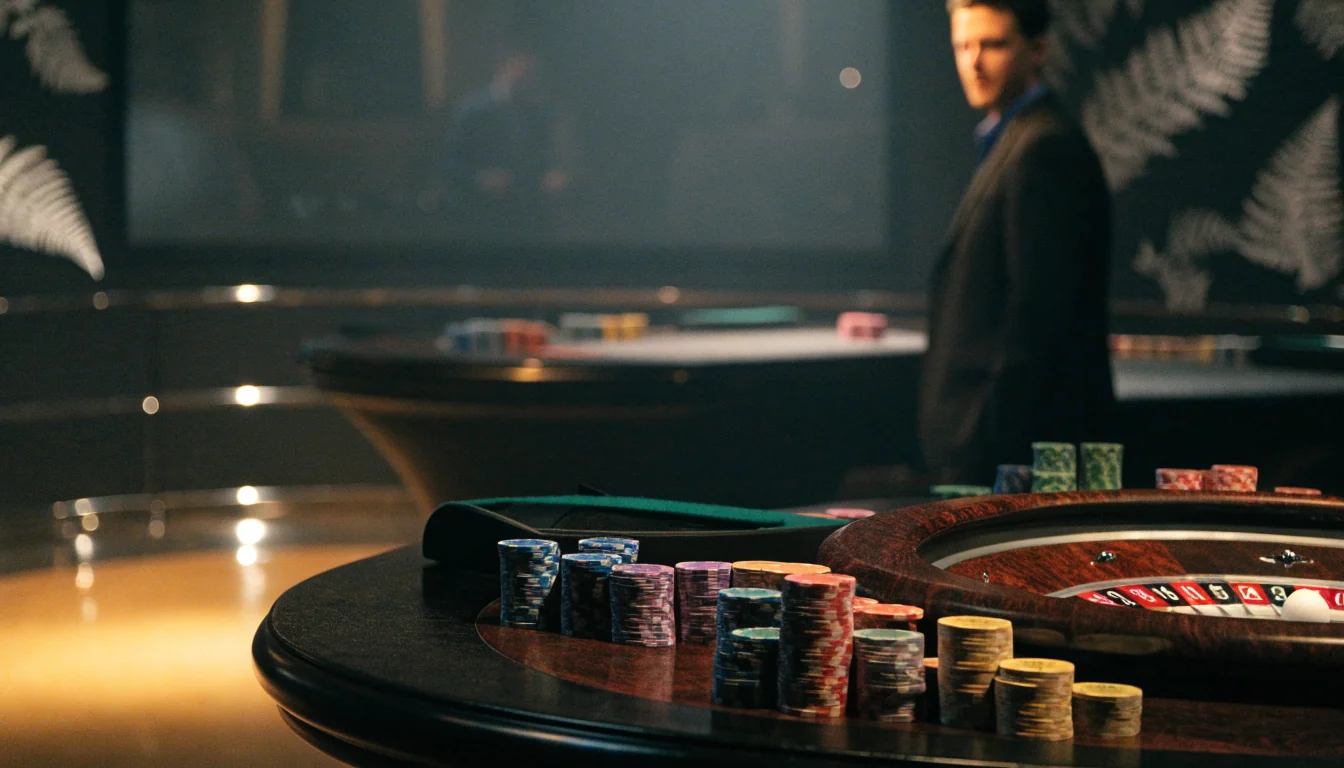
New Zealand’s Online Casino Licensing Transition in 2026
The rules governing online casino gambling in New Zealand changed in 2026. The Online Casino Gambling Act 2026 took effect on 1 May, establishing a domestic licensing framework for a sector that had not previously been licensed or supervised by a New Zealand regulator. Live-dealer services fall within this change, even though their games are presented through live video rather than generated entirely by software.
The new system is capped: the Act permits no more than 15 licences for the online casino sector. That ceiling applies to the sector as a whole, not separately to live dealer tables, online slots or digital table games. Live tables share the same licence category as those other online casino products. A service offering live blackjack or roulette therefore falls within the online casino licensing regime rather than a separate licence class for live play.
The cap describes the maximum number of licences available; it should not be read as confirmation that all permitted licences have been issued. Nor does the number identify which operators have been approved. The regulatory change is a move towards a limited group of authorised providers, not a published ranking of live-dealer casinos. The legislation itself does not establish which operator offers the strongest tables or most suitable terms.
The transition to December
The period from the Act’s commencement to 1 December 2026 is a transition, rather than an immediate switch from the previous arrangement to a fully operational licensing regime. Online casinos that were already serving people in New Zealand before the Act took effect may continue during this window, subject to the transitional provisions. This allowance is limited to the transition; it does not create a permanent right to operate without a licence.
The position changes on 1 December. From that date, only 15 approved operators will be legally permitted to accept New Zealand players under the new regulations. Providers that have not applied for a licence must stop serving the market by the deadline. A pending application has a different interim position: a provider with an application awaiting a decision may continue operating without advertising until the Department of Internal Affairs reaches a decision.

An application is not the same as an approval. The distinction matters when interpreting claims about a live casino’s regulatory status: a provider that has applied is not thereby one of the approved operators permitted to accept New Zealand players after the transition. If an application is declined, the provider must cease its online casino operations in New Zealand and leave the market. The full licensed regime is expected to be operational in 2027, so the transition date should not be confused with the completion of every part of the licensing system.
What the change means for live tables
For Kiwi players considering live dealer casinos, the key regulatory point is that live tables are included in the same licensing framework as other online casino games. The presence of a live dealer does not place a service outside the Act, and a separate “live casino” licence is not provided for in the stated categories. The new limit applies across the online casino sector, including providers of live tables.
New Zealand does not issue a Kiwi-specific gambling licence. The new domestic framework is a national licensing arrangement for online casino gambling, rather than a licence category dedicated to live play or a label that describes an operator’s table technology. Consequently, descriptions such as “live casino” explain the format of a service, not its regulatory status.
This transition also changes the context in which offshore online casinos operate. Before the Act, online casino gambling supplied from outside New Zealand was not licensed or supervised by a New Zealand regulator, and customers had no domestic government recourse in relation to that activity. The Act creates a route to domestic authorisation, but its transition provisions determine which existing providers may continue while the new system is being implemented. The distinction between the earlier position and the new framework is important: the legal arrangement is changing, and the December deadline marks a significant boundary within that change.
The cap also places a limit on the number of providers that can be authorised, rather than guaranteeing that a particular kind of live table will be available from every licensee. The legislation groups live dealer tables with online slots and digital table games for licensing purposes; it does not require each approved operator to offer every game format. Regulatory approval and a particular table’s availability are therefore separate matters.
For an assessment of live casino services in 2026, the date is central. Before the transition deadline, some existing providers may operate under transitional provisions, while later acceptance of New Zealand players depends on approval under the new regime. The law’s shared category for live tables and other online casino games makes the relevant regulatory question the provider’s position under the online casino framework, not whether its games are streamed from a dealer table.
How Live-Dealer Casino Tables Work
A live-dealer table combines physical casino equipment with a digital viewing and play interface. Cards and wheels are real, and the person dealing is present in a studio or a casino in a particular country. The action is sent to players through a live video feed, rather than being generated entirely by casino software. This distinction is central to what “live” means: the game’s visible events take place at a physical table, while the online connection lets people follow and participate remotely.
The setting can be a dedicated professional studio or a casino-based location. In either case, the broadcast shows a dealer conducting play with real equipment. A player joining online is therefore not interacting with a filmed sequence or a pre-recorded round. The feed carries the activity as it happens, making it possible to take part in real time alongside other participants at the table.
The software still has an important role. It provides the route into the table and supports the online interaction around the broadcast. But the software-only format and a live table are not the same kind of experience: in a software-only game, the action is presented digitally, whereas a live-dealer game draws on a physical table, a human dealer and a video stream. The screen is the means of access; it does not turn the physical dealing into a computer-generated event.

Interaction with the dealer is another defining feature. The live feed enables players to engage with a professional dealer during the session, rather than simply watching a sequence of on-screen animations. The degree and form of interaction can depend on the table’s interface, but the defining point is that the dealer is part of the live broadcast and players can interact with that dealer through the online experience. This human presence gives the format a different character from games in which every visible action is controlled by software.
A live table is consequently both a broadcast and an online game environment. The broadcast conveys the physical activity; the connected interface lets remote players participate. These elements work together, but they should not be confused. A video image alone does not establish that a game is live: the format described here involves real equipment and a professional dealer conducting play as it is transmitted. Conversely, the existence of software around the table does not make the underlying cards or wheel virtual.
For Kiwi players considering a live-dealer experience, the term refers to this format rather than to a particular operator, studio or game. Live dealer tables may be streamed from professional studios or from casino locations in different countries. Their shared feature is real-time play against a real dealer through video, not a common physical venue. A platform can therefore provide access to a live table without being the place where the dealing occurs.
This arrangement also explains why the format differs in atmosphere from software-led casino games. The dealer’s actions and physical equipment are part of what appears on screen, so the experience is tied to an event taking place at the other end of the feed. Players are connected to that event remotely, rather than receiving only a computer-rendered representation of a table. The distinction is about how the game is presented and conducted, not a claim that one format is more reliable or offers better outcomes.

The label “live casino” can cover different table games, but the live component remains consistent: a real dealer operates physical equipment and the session reaches players as a video broadcast. What varies from table to table is the game being offered and the way its participation interface is arranged. Those differences do not alter the basic structure of the format. Understanding that structure makes it easier to distinguish live-dealer games from digital table games without assuming that every site, table or broadcast is identical.
The term therefore describes a combination of human dealing, real casino equipment and online transmission. The dealer and equipment belong to the physical side of the experience; video and the connected interface make remote participation possible. Neither element alone captures the full format. It is the link between a real table and a live online feed that allows players to take part while the game is being conducted.
Game Rules, Outcomes and House Edges
Live table games differ not only in their format but in the decisions that determine a result. Blackjack centres on the player’s hand against the dealer’s; baccarat compares two hands; roulette is organised around outcomes on a wheel. These distinctions affect what a bet represents and how the house edge should be interpreted. The percentages available for roulette and baccarat describe particular versions or bet types, not a single figure that applies to every live casino game.
Blackjack: a hand against the dealer
In live blackjack, the aim is to finish with a total higher than the dealer’s without exceeding 21. A total above that limit fails to meet the objective, even if the dealer’s hand is lower. The result therefore depends on the comparison between the two hands and on whether either goes beyond the permitted total.
This makes blackjack different from games in which a player selects a side and waits for the outcome. The central question is how the player’s hand stands relative to the dealer’s. The basic objective is consistent, but the stated aim alone does not describe every possible table rule or every decision available during a round. Those details depend on the particular game offered.
The pace of a live blackjack round can also shape how its rules feel in practice: play proceeds through the hands at the table rather than resolving as a solitary software turn. That distinction concerns the experience of a round, while the underlying objective remains to beat the dealer without going over 21.
Blackjack
Objective is to finish with a total higher than the dealer's without exceeding 21.
Roulette
Outcomes are determined by a wheel, with house edges varying between European and American versions.
Baccarat
Compares the player and banker hands to see which is closest to 9.
Roulette: different edges by wheel type
Roulette outcomes are determined by a wheel, and the stated house-edge figures differ between European and American versions. For live European roulette, the edge is generally close to 2.7%; for the American version, it is about 5.26%. The gap matters when comparing the two formats: the wheel type is relevant to the mathematical disadvantage reflected by the quoted edge.
A house edge is a long-run measure of the casino’s mathematical advantage under the rules associated with a game or bet. It is not a prediction of the result of an individual round, nor does it mean that a particular player will lose a fixed proportion of a stake. Short sequences can produce outcomes that do not resemble the long-run measure. The figure is most useful as a way to compare stated game conditions, rather than as a forecast of immediate results.
For that reason, the European and American figures should not be treated as interchangeable. A description that merely labels a table “roulette” does not, by itself, identify which of these edge estimates applies.
Baccarat: banker, player or draw
Baccarat compares the player hand and the banker hand, with the winner being whichever is closest to 9. A bet can be placed on either side, and a draw is also a possible outcome. The object is to predict whether the player or banker will have the higher hand value, while recognising that a tie can occur rather than either side winning.

The stated house-edge estimates are different for the two main bets. A banker wager carries an edge of roughly 1.06%, while the corresponding figure for a player wager is approximately 1.24%. These are bet-specific measures, not a single edge for every possible baccarat outcome. A draw remains part of the game’s outcome set, but the figures for banker and player bets should not be read as a stated edge for a draw wager.
Reading the figures together
It would therefore be misleading to reduce all three games to one ranking based on the numbers alone.
For live casino games, the practical distinction begins with the structure of the wager. Blackjack evaluates a hand against the dealer’s, baccarat asks which hand comes closer to 9, and roulette is tied to the wheel version and the bet being considered. The quoted edges can help contextualise particular roulette and baccarat options, but they do not replace checking the rules attached to an individual table.
Bitcoin Deposits and Withdrawals
Bitcoin may appear among the payment methods associated with a live-dealer casino, but its presence alone says little about the terms attached to an account. A specialist review describes Bitcoin, Neteller and Skrill as methods that can offer fast deposits or withdrawals, while also noting that restrictions or fees may apply. This is a qualified description, not a guarantee that every operator supports the same Bitcoin services or applies identical conditions.
The distinction between a deposit and a withdrawal matters. A payment method listed for adding funds does not, by itself, establish that it can also be used to receive a payout. Nor does a general description of fast processing establish how long a particular Bitcoin transaction will take at a particular casino. The stated speed should therefore be read as a possibility, rather than as a fixed service standard.
Fees and limitations are also part of the payment terms, not incidental details. A Bitcoin option may be subject to conditions that affect whether it suits a particular transaction. The relevant terms are those attached to the individual operator’s payment service.
The connection between Bitcoin and live play is financial rather than game-specific. A live croupier table is still played through its live format; choosing Bitcoin as a payment method does not establish anything about the table’s rules, dealer interaction or betting conditions. Likewise, the label “live” does not imply a particular Bitcoin deposit or payout arrangement. These are separate parts of the service and need to be considered separately.
This distinction is useful when comparing a Bitcoin casino with live tables against another site offering similar games. A payment-method listing may show that Bitcoin is accepted in some capacity, but it does not settle whether that applies to deposits, withdrawals or both. It also does not disclose, on its own, any fees or limitations. A broad statement that Bitcoin can be fast cannot fill in those operator-specific details.
Promotional language should be treated with similar care. A live casino bonus or other promotion does not establish that Bitcoin transactions qualify for it, or that the same payment conditions apply to promotional and non-promotional funds. Any such relationship depends on the terms stated for the particular service.
For Kiwi players considering a live-dealer casino that lists Bitcoin, the soundest reading is therefore narrow: Bitcoin is identified as a payment method that may allow fast deposits or withdrawals, and restrictions or charges may apply. That description does not establish uniform processing, fees, or availability across operators. It also does not mean that every Bitcoin-listed site offers the same combination of deposit and withdrawal functions.
Bitcoin can be relevant to the practical use of an online casino, but the label alone is not a complete account of the payment arrangement. The distinction between potential speed and confirmed terms remains central: a general characterisation of Bitcoin payments cannot substitute for the conditions that govern a particular transaction.
Assessing Live Casino Sites Without an Operator Ranking
A sound assessment of a live casino site begins with regulatory evidence, not a broad label such as “trusted” or “best”. For Kiwi players, the relevant questions are whether the operator is subject to oversight by a recognised gambling authority and whether its stated licence can be checked independently. A licence logo or a claim in a site’s own promotional material is not, by itself, confirmation of regulatory standing.
The distinction matters because New Zealand does not issue a Kiwi-specific gambling licence. A site’s reference to a foreign licence therefore should not be mistaken for a New Zealand licence. The regulator named by the operator provides one point to examine, while the Department of Internal Affairs is the place to check the operator’s licence status in relation to New Zealand’s regulatory arrangements.
What a licence check can establish
Regulatory status is a specific question, separate from the quality of a site’s games or its presentation. The operator’s name and the licence information it displays should be considered together when checking its standing. If the information cannot be matched or clarified through the relevant official channels, the site’s own description remains an unverified claim.
- Check if the operator is subject to oversight by a recognised gambling authority.
- Independently verify the stated licence through official channels.
- Consult the Department of Internal Affairs to confirm the operator's licence position in New Zealand.
This approach avoids treating a polished live casino site as evidence of oversight. A convincing interface, extensive table selection or visible dealer stream does not establish that an operator is regulated. Nor does the presence of a foreign licence automatically establish that the operator has the status it claims. Verification concerns the operator and the licence, rather than the appearance of the service.
The Department of Internal Affairs should be consulted for confirmation of an operator’s licence position. That step is particularly relevant when a site makes statements about permission to serve people in New Zealand. The regulator’s confirmation is more informative than an operator’s wording alone, while a foreign gambling authority’s oversight remains a separate consideration.
Currency is a practical, separate check
Currency availability is another useful point of comparison, but it should not be confused with regulation. Many operators allow deposits and withdrawals in New Zealand dollars. That can make the displayed balance and transaction amounts easier to interpret, but NZD availability does not demonstrate that a site is properly regulated or that its licence details are accurate.
The payment terms should be read as part of the operator’s own conditions rather than inferred from a currency symbol on a page. A site may show NZD as an available currency while other conditions still apply. The fact that an operator accepts or pays out in NZD is therefore a practical feature, not a regulatory endorsement.
The same distinction applies to claims about a “best live casino site” in New Zealand. There is no defensible operator ranking based on currency alone, and a site’s regulatory position cannot be inferred from a payment option. A more grounded comparison separates these criteria: confirm the licence status through the Department of Internal Affairs, consider whether the operator is overseen by a recognised gambling body, and then assess whether NZD is supported under the site’s stated terms.
This method does not establish that every live casino site offers the same protections or currency arrangements. It keeps the assessment tied to verifiable points and avoids treating marketing language as proof. Regulatory standing and NZD availability answer different questions; neither should be used as a substitute for the other.
Accessing Offshore Live Casinos from New Zealand
Choosing a live casino in New Zealand means considering what each operator can reliably tell you about its credentials and service. This overview highlights the specific details available for each option.
-
N1 Casino
- License
- Malta Gaming Authority, licence no. MGA/B2C/394/2017
N1 Casino holds a Malta Gaming Authority licence, number MGA/B2C/394/2017.
-
Wintino
- Payout speed
- 1-3 business days
Wintino lists a payout speed of 1–3 business days.
-
Neospin
- License
- Tobique Gaming Commission, licence no. 0000064
Neospin is licensed by the Tobique Gaming Commission under licence number 0000064.
-
7Bit Casino
- License
- Tobique Gaming Commission, licence no. 0000091
7Bit Casino is licensed by the Tobique Gaming Commission under licence number 0000091.
-
Zotabet
- License
- 07017519840
- Payout speed
- 1-3 business days
Zotabet lists licence number 07017519840 and a payout speed of 1–3 business days.
-
BitStarz
- License
- Curaçao Gaming Authority, licence no. OGL/2024/165/0185
BitStarz holds a Curaçao Gaming Authority licence, number OGL/2024/165/0185.
-
Play Grand
- License
- Malta Gaming Authority, licence no. MGA/B2C/370/2017
Play Grand holds a Malta Gaming Authority licence, number MGA/B2C/370/2017.
-
Lamabet
- Payout speed
- 1-3 business days
Lamabet lists a payout speed of 1–3 business days.
-
Ricky Casino
- License
- Tobique Gaming Commission, licence no. 0000002
Ricky Casino is licensed by the Tobique Gaming Commission under licence number 0000002.
Kiwi players can access live dealer games through international or offshore gambling sites. That access is distinct from the question of whether a platform holds a New Zealand licence: New Zealand has not had a domestic licensing framework for online casinos, and the availability of a site does not itself establish domestic authorisation.
This distinction matters because “online live casino NZ” can describe two different things: a service reachable from New Zealand, or a service operating under New Zealand’s regulatory arrangements. Offshore platforms may offer live dealer tables to people in the country, but their location and regulatory status are separate from the fact that a player can reach them. Access alone should not be read as evidence that the operator is licensed locally.
The Online Casino Gambling Act 2026 has introduced a domestic framework, but the licensing transition does not make every accessible offshore site a New Zealand-licensed service. Nor does the absence of a domestic licence, by itself, mean that Kiwi players are prohibited from using an offshore platform. The legal position for operators and the position of players are not interchangeable.
Live dealer games played through an offshore site are therefore international services accessed from New Zealand, rather than proof of a domestic casino market. The platform may provide live tables to Kiwi players while remaining outside New Zealand’s licensing arrangements. This distinction is more informative than treating every site available in the country as a local operator.
A search for the best live online casinos in NZ may consequently return services with different regulatory positions. The phrase describes where the service is being accessed, not necessarily where it is based or which authority regulates it. For the same reason, “real” live dealer play does not indicate a New Zealand licence: it refers to the type of casino service, not its legal status.
The central point is that access to offshore live dealer casinos is permitted for players, while access does not resolve the operator’s regulatory standing. These are separate questions and should not be conflated when describing the market.
Real-Money Play and the Limits of Free Live Games
Free-play versions are not generally available for live dealer tables. The central difference from a software-only game is that a live table requires ongoing casino operations: a studio, equipment and professional staff must support the broadcast. Those costs continue whether a particular player stakes money or not, making a no-stakes version less straightforward to provide.

This does not mean that every online casino handles access in the same way. Real-money participation is therefore the usual context in which these games are made available, rather than a demonstration mode that can be assumed to accompany every table.
That distinction matters when comparing live play with games designed to run entirely through software. A digital game can be presented without a live production, while a real live casino table depends on people and physical operations as well as its online interface. Offering unrestricted practice access would not remove those underlying costs. The absence of a free option should therefore be understood as a consequence of the format, not as evidence about the quality or fairness of a particular table.
For Kiwi players looking to play live casino games online, the practical implication is limited but clear: free access should not be expected as a standard feature. Where a site does provide a way to view or try a table without wagering, that availability is specific to the operator and game. It does not change the broader cost structure behind live dealing, nor does it establish that all live games can be tested without real-money play.
The distinction also keeps the decision about participation separate from the appeal of the format. A live feed and dealer interaction do not, by themselves, make a table free to use. In this category, the live service is resource-intensive to run, so access is generally tied to real-money play.
Betting Windows and the Pace of Live Play
Live tables run to a shared timetable rather than allowing each player to act whenever they choose. A betting window opens, players place or adjust their stakes, and betting closes before the next stage of the game. This structure helps coordinate a table with several participants, but it also means a missed window can prevent a wager on that round.
The pace depends partly on how many decisions must be completed in sequence. Live blackjack can take longer than its RNG counterpart because players act in turn and the dealer must also complete each turn. The interval between bets therefore includes other players’ decisions, not just the time needed for a player’s own action. A table with several active participants may feel less continuous than a software game that resolves play without waiting for people at the table.
Baccarat has a separate timing constraint in some live versions: players are required to complete their hands within specified periods. This can make the pace less flexible, particularly when decisions must be made before the table proceeds. The constraint applies to some games, not necessarily every live baccarat table, so it should not be treated as a universal feature.
These procedures affect how quickly a session moves, but they do not provide a reliable fixed duration for a round. The number of participants and the time taken for each decision can vary. Consequently, live betting involves accepting the table’s sequence and deadlines; it is not equivalent to placing a wager in a game that advances immediately after an individual choice.
Live Tables Across Devices and Technical Reliability
Live dealer tables sit within the same licensing category as online slots and digital table games. That classification concerns how these products are regulated; it does not establish that every table is available on every device. A mobile live casino experience therefore cannot be inferred from the licence category alone. Access may depend on the individual operator’s interface and the particular table offered.
Device access and technical reliability are also separate considerations. A table may be listed as available, yet live play depends on a functioning connection between the player’s device and the streamed game. A specialist review has reported that live dealer games can encounter technical problems. This is a report of possible interruptions, not evidence that faults are frequent across the market or that a particular device is more prone to them.
When a stream or connection is interrupted, the immediate concern is whether the table can continue to be viewed and used. The consequences may differ according to the point at which an interruption occurs and the operator’s procedures; no uniform outcome can be assumed from the available information. Nor does the shared licensing category specify how an operator handles a disrupted session.
For Kiwi players comparing desktop and mobile access, the relevant evidence is specific to the operator and table: whether the table is offered on the chosen device, whether the interface supports the live stream, and what the published terms say about interrupted play. These checks concern practical access and service handling, not a separate licence class for mobile tables.
Live Casino Withdrawal Times by Payment Method
Withdrawal speed depends on the payment route, but the available figures should be treated as reported estimates rather than a market-wide standard. A specialist review gives the following comparison: crypto payouts may clear in under an hour; POLi and e-wallet withdrawals are reported at 24 to 48 hours; and bank transfers at 5 to 7 business days. These ranges describe what that source reported, not a guaranteed timeframe for every live dealer casino.
The figures also measure different stages imperfectly. A payout may depend on both the operator’s processing and the payment network, so a stated interval does not necessarily mean funds will arrive within that period in every case. The source does not establish whether the estimates cover weekends, identity checks or other delays, and its timings may change.
For a Kiwi player comparing a live casino fast withdrawal option with a slower route, the meaningful distinction is therefore the reported category, not a promise of arrival time. Crypto has the shortest stated interval in this comparison, while bank transfers have the longest. POLi and e-wallets fall between them. These observations should not be taken as a universal ranking: payment availability and processing conditions can differ between operators, and the cited ranges alone do not establish the terms of any particular account.
Can New Zealand players play real-money live dealer games at offshore casino sites?
Yes. New Zealand players are not prohibited from accessing offshore live dealer games, but should choose a site regulated by a recognised gambling body and check its licence status with the Department of Internal Affairs.
How many operators can hold a licence?
The online casino sector, including live dealer tables, has a cap of 15 licences. This is a maximum, not a guarantee that all 15 licences have been issued.
Do live dealer games have a house edge?
Yes. For example, live European roulette usually has a house edge of about 2.7%, while live baccarat has an edge of about 1.06% on banker bets and 1.24% on player bets.
Which live dealer games can New Zealand players usually access?
Live blackjack, roulette and baccarat are among the live dealer games described for players.
Can players deposit and withdraw using New Zealand dollars at live casinos?
Yes. Many operators allow deposits and withdrawals in New Zealand dollars.
Live & Card Games in New Zealand: Blackjack and Baccarat
Content created by the «casinoinfonz.com» team